


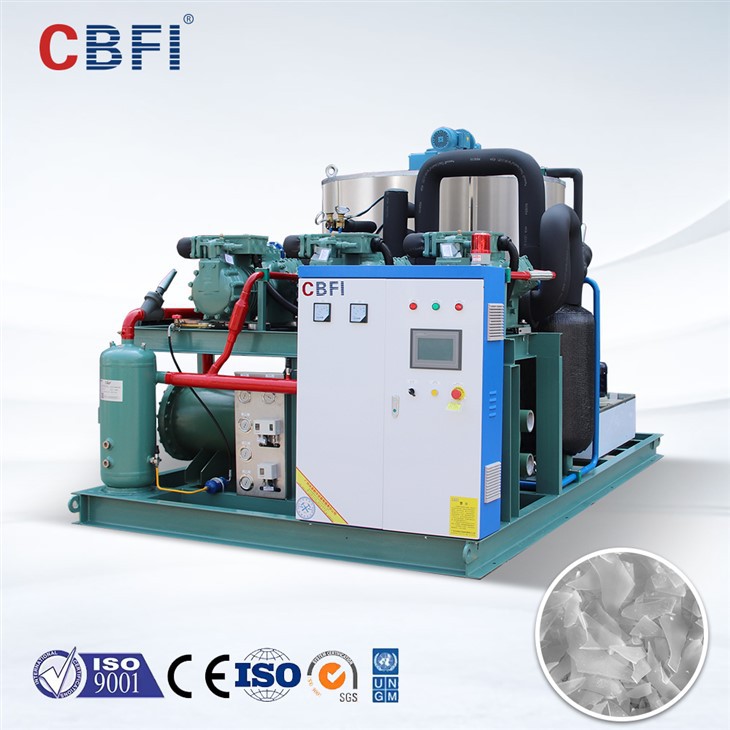
In the field of chemical production, temperature control of reaction vessels is the core link that determines production efficiency and product quality. For production enterprises with an annual output of 5000 tons of organic pigments, the limitations of traditional cooling technology have become a key bottleneck restricting capacity improvement. The CBFI technical team conducted in-depth analysis of industry pain points and developed a chemical reaction kettle cooling system with "intelligent ice making - efficient temperature control - precise conveying" as the core, which improves the refrigeration efficiency in chemical production to a new height.
**From Technical Dilemma to System Refactoring: The Innovative Path of CBFI Solutions**
During the pigment synthesis process, temperature fluctuations in the reaction vessel often lead to an increase in by-products and unstable reaction rates. Traditional water-cooled or air-cooled systems face three major challenges:
1. The cooling rate lags behind, and conventional cooling media are difficult to quickly match the peak heat release of the reaction;
2. Uneven distribution of ice crystals, artificial ice making can easily cause local supercooling or hot spots;
3. Energy management is extensive, and a single temperature control mode is difficult to adapt to the characteristics of different batches of raw materials.
The breakthrough of the CBFI team began with the reconstruction of the "direct contact between ice and reactants" mode, by integrating the entire process of ice making, storage, transportation, and delivery into an intelligent system, achieving:
-The ice particle size is precisely controlled at 3-5 millimeters to ensure uniform mixing with the reactants;
-The refrigeration efficiency has been improved by 40% compared to traditional processes, and the cooling response time has been shortened to within 3 minutes;
-While achieving fully automated closed-loop management, the system's energy consumption has been reduced by 28%.
**Collaborative Innovation of Core Components: Analysis of the Three Major Technical Pillars of the System**
1. * * Spiral ice scraping evaporation system - Reshaping ice making efficiency**
A patented spiral internal scraper made of multi-layer composite materials is used to scrape the inner wall of the evaporation tube at a high frequency of 180 revolutions per minute, which not only accelerates the peeling of the ice layer, but also uniformly ejects the ice crystals to the collection bin through centrifugal force, avoiding local supercooling caused by ice residue accumulation.
2. * * Intelligent ice storage device - precise storage and transportation in dry environment**
The dual circulation management (cold air insulation collaborative technology) equipped in the system has completely changed the traditional ice storage environment. The thermal insulation layer is made of aerogel and nano alumina composite materials. While maintaining a constant temperature of -5 ℃, directional airflow is formed through the top centrifugal fan, so that the evaporation rate of water on the ice surface is less than 0.5%. A dedicated vibration platform that operates automatically for 15 minutes daily ensures that the ice is naturally broken into loose particles, reducing mechanical losses during storage and transportation.
3. * * Multi functional ice rake equipment - clever embodiment of 450 ℃ hot-dip galvanizing process**
As the "intelligent execution terminal" within the system, the anti-corrosion ice rake integrates four innovations in its design:
-The steel frame is hot-dip galvanized at 450 ℃, with a corrosion resistance life five times that of ordinary materials;
-The rake head integrates an ultrasonic sensor array, which can scan the thickness of the ice layer in real time and automatically adjust the depth of the operation;
-The same device has functions of leveling, crushing, and pushing, reducing manual intervention;
-By presetting parameters through the touch screen, the linkage control of "ice thickness - conveying volume - reactor pressure" can be executed.
**System integration: full process control empowered by the Internet of Things**
At the digital level, the CBFI system achieves intelligent regulation through a three-tier architecture:
-Perception layer: including 32 sets of temperature and humidity sensors, 12 pressure transmitters, and 8 sets of weighing modules;
-Edge computing layer: the local server processes 120 groups of data per second to generate dynamic cooling curves;
-Cloud platform layer: Management personnel can monitor the real-time status of ice storage throughout the factory through a web platform and remotely adjust the parameters of the air pre cooling unit.
The specially designed 'buffer ice adding device' solves the problem of air ice mixing in traditional systems. The device adopts a honeycomb shaped flow guiding structure to achieve the separation and transportation of production airflow and circulating refrigerant in a closed pipeline. It not only avoids the odor carried by ice crystals, but also controls the ice crushing loss during the ice transportation process within 3% through a buffer chamber pressure reduction design.
**Industry Value: From Technological Breakthrough to Production Transformation**
The practical application of CBFI system has verified its multidimensional value:
-Efficiency improvement: significantly accelerated cooling response speed, unleashing production capacity potential;
-Quality assurance: Temperature fluctuations are controlled within ± 0.3 ℃, and the color difference rate is reduced to one-fifth of the ISO standard;
-Security upgrade: Fully automatic operation eliminates the risk of frostbite caused by manual ice making, with a system failure self check rate of 99.2%;
-Flexible expansion: Through the Internet of Things interface, it is possible to quickly connect with enterprise MES systems and achieve dynamic management of formulas in multi variety production.
The practice of CBFI has revealed three major development trends in the field of chemical refrigeration:
1. Collaborative innovation of materials and structures: shifting from single device optimization to system level material engineering design;
2. Intelligent perception deep fusion: upgraded from parameter monitoring to adaptive decision-making system;
3. Full lifecycle management: Incorporate equipment anti-corrosion performance and maintenance costs into initial design considerations.
Its modular design can flexibly adapt to different production capacity requirements, providing a cost-effective and forward-looking upgrade path for small and medium-sized chemical enterprises.
Hot Tags: Innovative Practice of Intelligent Cooling System for CBFI Reactor, China, manufacturer, factory, price, buy, 5 ton flake ice machine, flake ice machine for fish, ice flake making machine, commercial ice flake machine, flake ice machine


