


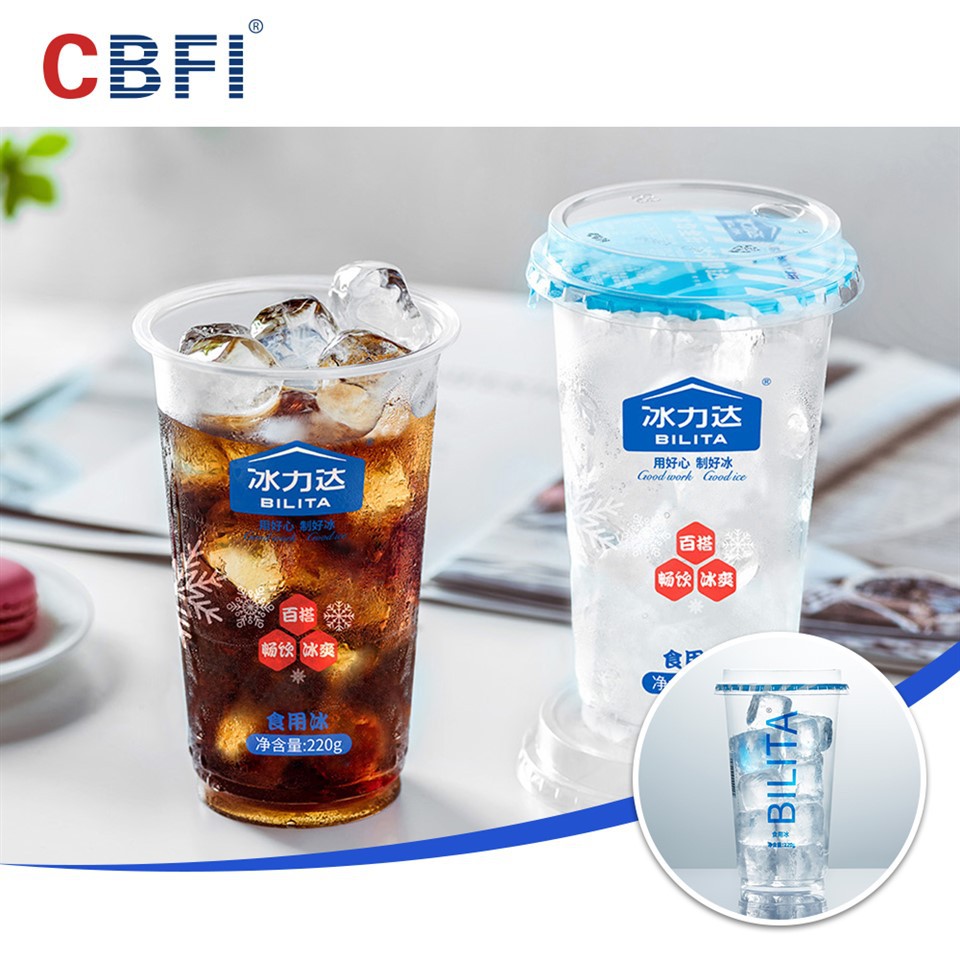
1. Market Trends: The Revolution from "Bulk Ice" to "Branded Ice Cups"
In the past, edible ice was mainly supplied in bulk bags to restaurants. However, with the rise of "home mixology" and "office coffee" culture, the standardized 220g ready-to-drink ice cup has become the new favorite of the retail end. This packaging not only solves food safety and hygiene concerns (fully sealed) but also enhances product added value through extreme convenience.
2. Core Question: How Much Space Do You Need?
Building a modern edible ice plant requires space planning based on automation levels and logistics. For a factory equipped with a CBFI automatic ice cup packaging line producing 30,000–50,000 cups per day, the following layout is recommended:
· Production Zone: Approx. 300–500㎡. Includes ice-making units, automatic dosing systems, sealing machines, and auto-packers.
· Cold Storage: Approx. 200–400㎡. Since ice cups are bulky and pressure-sensitive, finished product storage requires high-rack systems.
· Auxiliary Zones: Approx. 200㎡. Includes water treatment, sanitization rooms, labs, and packaging material storage.
Total Recommended Area: Starting from 800–1,200㎡.
3. Technical Core: Excellence of the CBFI Automatic Ice Cup Line
As a global leader in the ice-making industry, CBFI (Guangzhou Icesource) has developed the 220g/cup automatic production line specifically optimized for high-frequency retail scenarios. Its core advantages include:
Precise Dosing
Traditional bulk bagging is prone to errors, whereas the CBFI system uses multi-head weighers or high-precision volumetric dosing to ensure the 220g per cup error is minimized, protecting profits and meeting metrological standards.
High-Efficiency Automation
From automatic cup dropping, UV sterilization, ice filling, and heat sealing to automatic casing, the entire process requires no human contact. This significantly reduces labor costs and ensures the product meets stringent "food-grade" hygiene requirements.
Flexible Customization
While 220g is currently the top-selling specification, CBFI equipment supports quick mold changes, compatible with 180g, 250g, and other cup types, helping businesses respond quickly to market changes.
4. Economic Analysis: Profit Logic of 30,000–50,000 Cups/Day
Taking a daily output of 40,000 cups as an example:
· Retail Unit Price: In the consumer market (C-stores), a cup of ice usually retails for 3–5 RMB (approx. $0.4–0.7).
· Gross Margin: After deducting packaging (cup + film), water, electricity, labor, and cold chain logistics, the profit margin per cup remains substantial.
· ROI Period: Relying on the high stability of CBFI equipment (24-hour continuous operation), equipment investment can typically be recovered within 8–14 months given mature distribution channels.
5. Why Choose CBFI?
Unlike traditional equipment traders (such as certain resource aggregators), CBFI provides a Full Chain Turnkey Project.
· We have a professional ice-making process lab capable of providing customized solutions based on local water quality and climate.
· Our service network spans the globe, ensuring your automated line stays in peak condition under high-load operations.
· We assist clients in planning purification workshops that comply with HACCP and GMP standards, ensuring they pass government regulatory audits.
Edible ice is no longer just a cooling tool; it has become a carrier of lifestyle. Choosing the CBFI Automatic Ice Cup Production Line is not just choosing a machine; it is choosing a mature, efficient, and profitable business model.
Hot Tags: edible ice plant cbfi automatic ice cup production lines, China, manufacturer, factory, price, buy


