


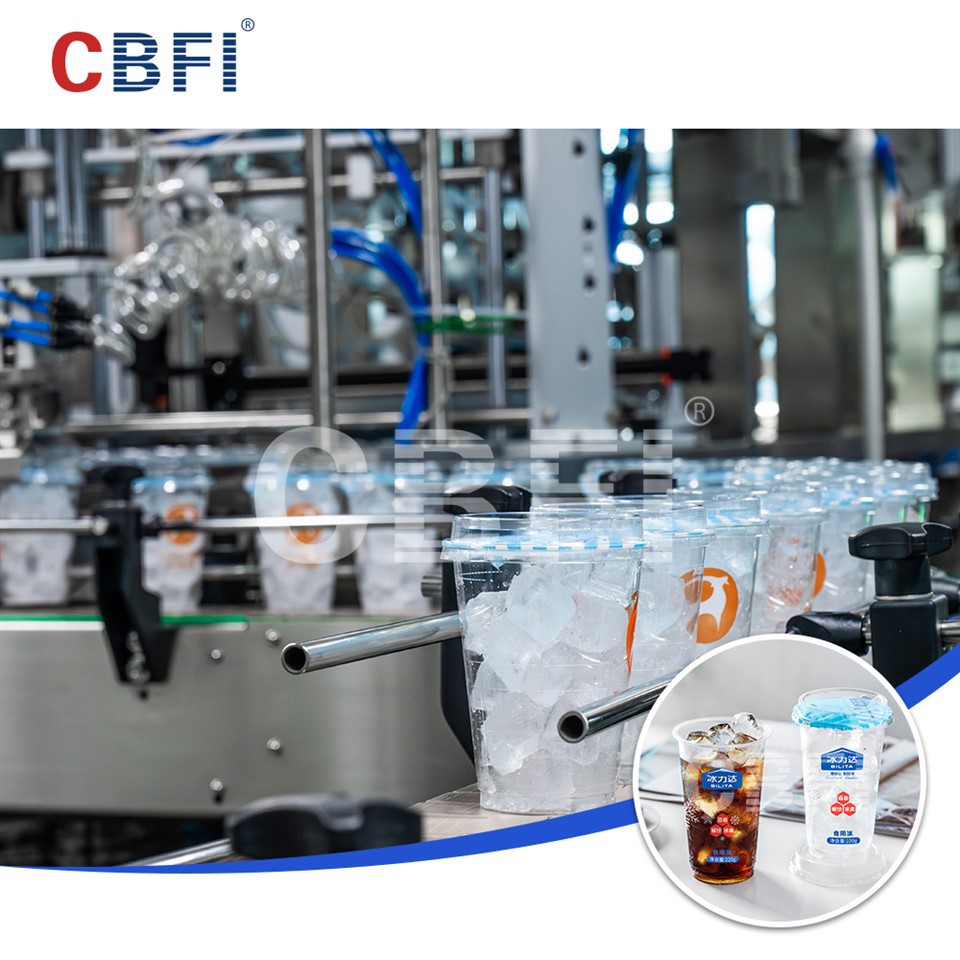

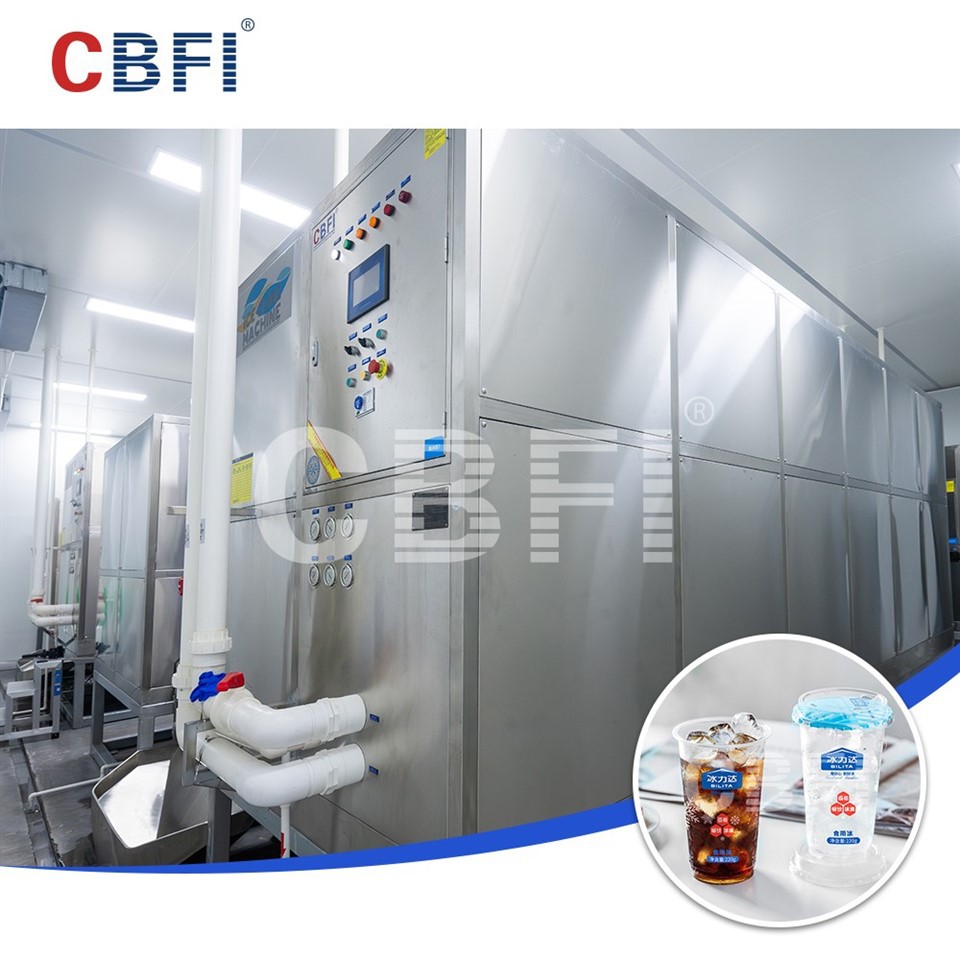
Core Engineering Breakthrough 1: Kinematic Synchronization System
In high-speed ice cup filling systems, one of the key bottlenecks is material bridging and inconsistent discharge flow, caused by irregular ice geometry and low friction characteristics.
CBFI solves this through dynamic system synchronization between ice generation and packaging modules.
Key Technologies:
Active Vibration Anti-Bridge System
High-frequency micro-vibration sensors installed in hopper zones
Real-time flow monitoring and automatic blockage elimination
Prevents ice accumulation and line stoppage
Servo Precision Volumetric Dosing
Servo-driven rotary metering system replaces time-based filling
Angle-controlled dispensing ensures stable cup weight
Minimizes overfill and sealing failure rates
Core Engineering Breakthrough 2: Thermal Integrity Management System
Ice cup production environments face a critical issue: condensation and moisture contamination caused by temperature differentials.
CBFI introduces a controlled thermal isolation architecture.
Key Technologies:
Positive Pressure Dry Air Curtain System
Creates a localized dry-air micro-environment at filling and sealing stations
Prevents external humidity intrusion
Ensures stable sterile sealing conditions
Anti-Icing Filling Head Design
Teflon-coated dispensing nozzles
Integrated thermal compensation system
Prevents freezing, clogging, and frost buildup during continuous operation
Core Engineering Breakthrough 3: Hygienic Engineering Design (HACCP+ Level)
For direct-consumption ice products, hygiene is a critical compliance requirement.
CBFI systems are engineered under industrial-grade hygienic design standards exceeding conventional HACCP requirements.
Structural Standards:
Full SUS316L food-grade stainless steel contact surfaces
No dead zones or hidden contamination points in flow paths
Corrosion-resistant design for long-term cold-chain sanitation
CIP Cleaning System Compatibility:
Full-line Clean-in-Place capability
Sanitary quick-connect piping system
Deep cleaning cycle completed within ~30 minutes
Maximized production uptime with minimal downtime
Business Value Transformation: From Cost Center to Revenue Engine
CBFI ice cup production lines are not only manufacturing systems-they are scalable retail production assets.
| Dimension | Traditional Semi-Automated Line | CBFI Autonomous Ecosystem |
|---|---|---|
| Labor Requirement | 5–8 operators | 1 monitoring operator |
| Production Stability | High variability, frequent downtime | Fully stable 24/7 operation |
| Defect Rate | High crushed ice + sealing errors | Crushed ice < 2%, sealing > 99.5% |
| Peak Season Response | Capacity bottleneck | Continuous high-load output |
| Brand Value | Limited traceability | Standardized FMCG-grade packaging |
Strategic Industry Impact
The CBFI Autonomous Ice Cup Production Ecosystem enables:
Industrial-scale conversion of ice into FMCG retail products
High-throughput standardized cold beverage supply chains
Reduced labor dependency through full automation
Enhanced brand premiumization via standardized packaging quality
Defining the Future of Ice Manufacturing
CBFI's Ice Cup Production Ecosystem represents a convergence of:
refrigeration engineering + industrial automation + hygienic manufacturing systems
It is not simply an equipment upgrade-it is a structural redesign of the ice supply chain, enabling global customers to transition from fragmented production to fully autonomous, scalable cold product manufacturing networks.
Hot Tags: CBFI Autonomous Ice Cup Production Ecosystem, China, manufacturer, factory, price, buy


