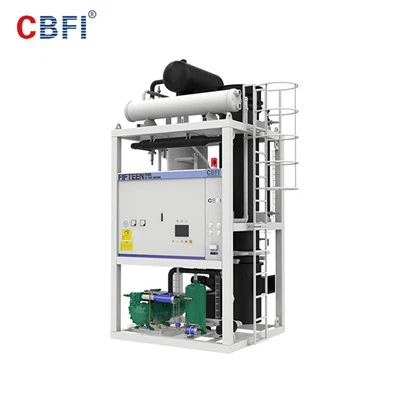


Industry Challenges in Cup Ice Production
1. Strict Requirements from Beverage Applications
Cup ice used in beverages must meet strict standards:
High transparency and cleanliness
Uniform size control (typically 45–55 mm diameter range)
Food safety compliance (e.g., GB 4806.7 food-contact material standards)
Fast and continuous supply during peak hours
Any deviation in size or clarity directly impacts beverage consistency and brand image.
2. Inefficiency of Traditional Systems
Conventional cup ice production typically relies on semi-manual processes, leading to:
High labor dependency across filling, demolding, and transfer stages
Low automation stability during continuous operation
Frequent operational errors affecting ice integrity
Limited production capacity during peak consumption periods
In addition, energy performance is often poor:
Low COP efficiency (~1.2 in traditional systems)
High annual electricity consumption
Significant carbon emissions and operational costs
CBFI Cup Ice Production Line: Core System Architecture
1. Full-Process Automation System
The CBFI production line integrates four key modules:
Water treatment system
Automated ice forming system
Sterile packaging system
Intelligent storage and logistics system
This enables a fully closed-loop, unmanned production workflow from raw water intake to finished ice storage.
Advanced Water Purification System
To ensure ice clarity and safety, the system includes:
Multi-stage filtration
Reverse osmosis (RO) purification
Water quality standard: near-drinking level (TDS < 10 ppm)
Additionally:
Real-time liquid level monitoring
Automated water replenishment control
Overflow and shortage prevention logic
This ensures consistent and stable production conditions.
2. Flat Wall Turbulent Heat Exchange Technology
A core innovation of the CBFI system is its patented flat wall turbulent heat transfer design, which significantly improves freezing efficiency.
Key engineering features:
3D serpentine flow channels inside the mold
Transverse hole array structure to induce turbulent flow
Heat transfer efficiency improved by approximately 50%
Dynamic evaporator temperature control (-18°C to -25°C range)
Result:
Batch ice formation time reduced to ~8 minutes
Improved ice clarity and structural uniformity
More stable production under varying ambient conditions
3. Fully Automated Sterile Handling System
After ice formation:
Robotic arms transfer ice cups automatically
UV sterilization chamber achieves >99.9% surface sterilization
AGV automated vehicles handle internal logistics
Transfer time exposed to air is controlled within 15 seconds
This minimizes contamination risk and ensures hygienic production.
4. Smart Warehousing and Demand-Driven Supply
The system integrates with store-level demand management systems:
POS-linked inventory replenishment
Priority supply during peak consumption periods
Intelligent warehouse temperature control
Inventory turnover optimization (+30% improvement)
This ensures stable supply during high-demand periods such as lunch and evening rush hours.
Food-Grade Safety and Compliance System
1. Hygienic Material Design
All components in contact with ice are designed for food safety:
Medical-grade 304 stainless steel
FDA-certified silicone molds
Smooth surface structure with no dead corners
Anti-contamination structural design
2. Clean Production Environment
Fully enclosed clean production workshop
ISO Class 7 cleanroom standard
PM2.5 maintained below 5 μg/m³
Controlled airflow and dust isolation system
3. Full Traceability System
Each batch of ice cups includes:
Production time records
Operator identification
Water quality data logs
Batch-level traceability tags
This supports full lifecycle quality tracking and compliance audits.
System Adaptability and Engineering Advantages
1. High-Stability Operation in Harsh Environments
The system is designed for industrial reliability:
Stable operation in 40°C high-temperature environments
IP67-rated protection for key components
Moisture and dust resistance for tropical conditions
2. Low Maintenance Design
Self-cleaning mold coating technology
Maintenance cycle extended from weekly to monthly
Reduced downtime and service cost
3. Modular Expansion Capability
The system supports flexible upgrades:
Optional pre-freezing enhancement module
Adjustable production capacity configurations
Cloud-based monitoring and predictive maintenance
System availability up to 99.5%
Conclusion
The CBFI cup ice production line system transforms traditional ice manufacturing from a labor-intensive process into a fully automated, hygienic, and data-driven industrial system.
By integrating:
High-efficiency heat exchange technology
Full-chain automation
Food-grade safety design
Smart logistics and demand management
CBFI enables beverage and catering brands to achieve stable ice supply, improved operational efficiency, and enhanced product consistency.
In a highly competitive beverage market, ice quality is no longer a secondary factor-it is a direct representation of brand quality. The CBFI system positions cup ice production as a scalable, industrial-grade backbone for modern beverage operations.
Hot Tags: cbfi cup ice production line system, China, manufacturer, factory, price, buy