


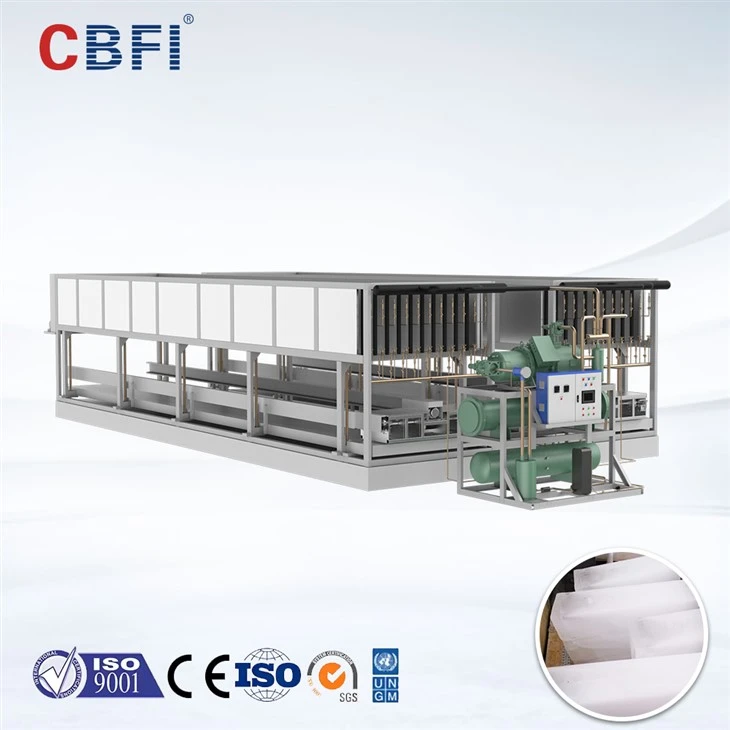
What Is a Direct Cooling Ice Block Machine?
A direct cooling ice block machine is an industrial ice production system where refrigerant directly cools the ice mold to form solid ice blocks.
Compared with brine-type systems, direct cooling technology simplifies the ice-making process and improves operational efficiency in continuous production environments.
The system is widely used in industrial sectors requiring stable and high-strength ice blocks for storage and transportation.
Key Technical Parameters
| Item | Specification |
|---|---|
| Ice Production Capacity | 3000–50000 kg / 24h |
| Ice Type | Solid Ice Block |
| Ice Hardness | ≥ 200 kg/cm² |
| Energy Efficiency | 15–25% higher than conventional systems |
| Operating Temperature | -5°C to 45°C |
| Maintenance Cycle | Standard maintenance every 12 months |
| Design Type | Modular industrial system |
Why Fisheries and Food Industries Use Direct Cooling Ice Block Machines
1. Fisheries and ocean fishing operations
Fishing vessels require stable ice for long-duration storage of caught seafood.
In offshore environments:
Ice melting speed directly affects seafood freshness
Water from melting ice can impact storage hygiene
Long-distance transport increases ice demand
Direct cooling ice blocks provide higher structural strength, helping reduce melting loss during fishing and transport operations.
2. Food processing plants
Food processing facilities require continuous ice supply for:
Slaughtering operations
Meat cooling processes
Production line temperature control
Traditional ice systems may require frequent maintenance shutdowns, which can interrupt production flow.
Direct cooling systems are designed for continuous operation, supporting stable ice supply in high-demand environments.
3. Cold chain transportation
During long-distance transport, ice stability becomes critical.
Key requirements include:
Slow melting rate
Stable stacking structure
Reduced temperature fluctuation
Direct cooling ice blocks help reduce ice loss during transport and improve temperature consistency.
System Advantages
Stable Ice Hardness
The system produces high-density ice blocks suitable for long-term storage and transportation.
This helps reduce structural breakage and melting loss during handling.
Continuous Industrial Operation
The equipment is designed for 24-hour operation in industrial environments.
It is suitable for facilities requiring uninterrupted ice supply.
Energy Efficiency Improvement
Compared with traditional ice-making systems, direct cooling technology improves energy utilization efficiency under stable operating conditions.
Modular Maintenance Design
The system uses a modular structure, allowing key components to be serviced or replaced individually.
This reduces downtime during maintenance cycles.
Application Scenarios
Fisheries industry
Fish preservation onboard vessels
Port landing storage
Seafood distribution support
Food processing industry
Meat processing plants
Poultry processing lines
Slaughterhouse cooling systems
Cold storage logistics
Warehouse temperature control
Cold chain buffering systems
Distribution center cooling support
How to Calculate Ice Demand
Fisheries sector
Ice demand is typically calculated based on:
Vessel storage capacity
Catch volume
Storage duration
Ambient temperature conditions
Food processing plants
Ice demand is based on:
Hourly consumption of production lines
Daily operating hours
Process cooling requirements
Cold chain logistics
Ice demand depends on:
Transportation distance
Load volume
Target temperature range
Storage container insulation level
Why Direct Cooling Ice Blocks Are Widely Used
Compared with traditional ice systems, direct cooling ice blocks offer:
Higher structural strength
Lower melting loss
Easier transportation handling
More stable storage performance
This makes them suitable for industrial-scale cold chain applications.
Maintenance and Operation
The system is designed for simplified maintenance in industrial environments.
Routine inspection cycle: 12 months
Modular component replacement reduces downtime
Designed for continuous industrial operation
Frequently Asked Questions
What is the main difference between direct cooling and brine ice machines?
Direct cooling systems use refrigerant directly for ice formation, simplifying the system structure and improving operational efficiency in continuous production environments.
Can the system run continuously?
Yes. The system is designed for 24-hour industrial operation with stable ice output.
Is the machine suitable for offshore fishing vessels?
Yes. It is suitable for marine environments where stable and high-strength ice blocks are required for seafood preservation.
How is ice hardness important?
Higher ice hardness reduces melting loss during transportation and improves storage stability in long-distance cold chain logistics.
Industrial Value of CBFI Ice Block Systems
CBFI direct cooling ice block machines are designed for industrial users requiring:
Stable ice supply
Continuous production capability
Reduced maintenance downtime
Improved cold chain efficiency
The system is widely applied in fisheries, food processing, and logistics cold chain infrastructure projects.
Hot Tags: CBFI Direct Cooling Industrial Ice Block Machine, China, manufacturer, factory, price, buy, clear ice block maker machine, industrial ice block making machine, industrial ice block maker, commercial ice block machine, 1 ton ice block making machine


