

SECTION 1: Why Choose CBFI® Spiral Freezers?
1. High-Volume Processing in a Compact Footprint
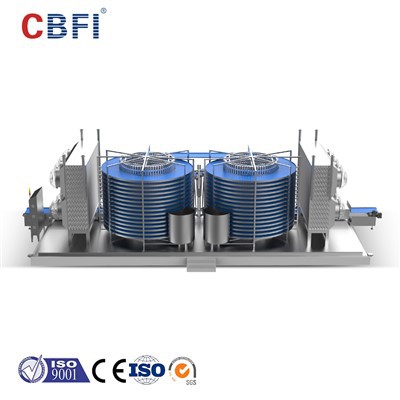
Designed to scale alongside your business, the CBFI® Double Spiral system offers a massive output range of 300 to 10,000 kg/h. By taking your freezing process vertical, it utilizes up to 60% less floor area than a horizontal tunnel freezer with equivalent capacity, leaving precious room for prep-lines and packaging systems.
2. Flexible Layout Configurations (Types A, B, and C)
Every food manufacturing facility is built differently. To accommodate diverse entry and exit directions of upstream proofers/ovens and downstream packaging machines, our double-spiral architecture can be dynamically configured into Type A, Type B, or Type C layouts based on the relative position of the inner cage and the evaporator.
3. Synchronous Drive & Gentle Product Handling
Our advanced Quick-Freezing Tumbler ensures that the mesh belt and the rotating cage run in perfect synchrony. This eliminates belt slipping, jerky movements, and friction wear, keeping delicate products like decorated pastries, unbaked dough, and bento-box prepared meals structurally flawless. Furthermore, the modular mesh belt is engineered for quick, tool-free replacement.
SECTION 2: Technical Specifications & Parameters
| Component / Parameter | Standard Specifications |
| Structure Type | Double Spiral (Type A, B, or C Layouts available) |
| Production Capacity | 300 kg/h to 10,000+ kg/h |
| Drum / Cage Diameter | 1,620 mm to 5,800 mm |
| Mesh Belt Layers | Level 6 to Level 40 |
| Mesh Belt Width | 520 mm to 1,220 mm |
| Mesh Belt Material | Premium food-grade SUS304 Stainless Steel or High-Performance POM |
| Infeed / Discharge Length | 500 mm standard (customizable to upstream/downstream lines) |
| Control System | Advanced Siemens/MCGS Touch Screen PLC, SUS304 cabinet |
| Refrigerant Options | Freon (R404A / R507 / R448A), Ammonia (NH3), or Carbon Dioxide (CO2) |
| Evaporator Construction | Aluminum/stainless steel tubes with aluminum or aluminum-magnesium alloy fins |
| Defrosting Method | High-pressure water flushing or hot air defrosting |
| Freezing / Cooldown Time | Variable-frequency adjustable (VFD drive matching target food profiles) |
| Sanitary Cleaning Method | Integrated mesh belt washing unit / Clean-In-Place (CIP) |
SECTION 3: Premium Mechanical Features & Hardware Quality
Double-Surface Polyurethane Insulation Enclosure:
Constructed from 120mm to 150mm thick rigid high-density polyurethane (PU) foam cores cladded on both sides with thick SUS304 stainless steel interior and exterior skins. Completed with double-gasket door seals, this enclosure eliminates cold-bridge leakage and significantly reduces energy draw.
Large Variable-Fin Pitch Evaporator:
Custom-engineered with wide fin spacing at the product inlet and standard spacing at the outlet. This delayed-frost design drastically extends the continuous running time of your freezing shift before requiring a defrost cycle.
Full-Grade SUS304 Internal Sanctuary:
Every structural column, guide rail, chain link, and fan shroud is fabricated entirely from food-safe SUS304 stainless steel, preventing chemical reactions, resisting corrosion from sanitation chemicals, and ensuring absolute compliance with FDA and international hygienic food codes.
Seamlessly Sloped Drainage Floor:
The entire internal chamber floor pan is seamless, heavy-gauge welded stainless steel, sloped toward multiple high-capacity floor drains. This design guarantees that washdown water and defrosted ice drain completely away, preventing bacteria-harboring stagnant pools.
SECTION 4: Primary Application Fields
Our industrial double spiral systems are engineered to handle dense, high-occupancy, or delicate products across multiple premium food sectors:
Bakery & Pastry Industry: Perfect for high-capacity proofed dough, croissants, par-baked breads, and cakes.
Prepared Dish Manufacturing: Locks in the flavor, texture, and visual presentation of bento box meals, pre-cooked entrees, and multi-component prepared foods.
Frozen Pastry & Dim Sum: Preserves cell wall integrity for delicate dumplings, buns, and wontons, keeping skins soft and fillings succulent during final thawing.
Poultry & Meat Processing: Designed to freeze high-density meat patties, chicken tenders, sausage links, and pork cuts safely without moisture bleeding or weight loss.
SECTION 5: Double Spiral Freezer FAQs
Q1: What is the primary operational advantage of a Double Spiral Freezer over a Single Spiral?
A: A double spiral freezer utilizes two rotating drums in series. Typically, products enter on a low infeed belt, spiral upwards around the first drum, transfer smoothly across an overhead bridge, and then spiral downwards around the second drum to exit at a low discharge point. This aligns perfectly with single-level factory floor operations and extends retention time for thick, high-occupancy items.
Q2: What is the difference in application between SUS304 and POM mesh belts?
A: Premium SUS304 stainless steel belts are highly durable, resistant to extreme temperatures, and ideal for heavy meat products or hot-baked items fresh from the oven. Food-grade POM (polyoxymethylene) modular plastic belts offer non-stick surface properties, are exceptionally gentle on delicate pastry skins, and are lighter, which reduces mechanical drag and energy consumption.
Q3: How does the system prevent large ice crystals from forming in foods like dumplings and prepared dishes?
A: High-pressure aerodynamic fans blast air at -35°C to -40°C over the spiral layers, quickly forcing the food's core temperature below -18°C. This rapid freeze passes products through the critical ice-crystal formation zone (-1°C to -5°C) in minutes, ensuring that moisture forms microscopic crystals that do not rupture cell walls.
Q4: What type of clean-in-place (CIP) features are integrated?
A: The system features an automatic mesh belt washer coupled with an optional multi-angle high-pressure piping network. This CIP setup flushes the belt, cage tracks, and evaporator coils with hot water and sanitizing agents, drastically reducing manual labor and keeping downtime to a minimum.
Q5: Can we adjust the freezing times for different foods on the same machine?
A: Yes. The drive mechanism is equipped with variable frequency gearboxes. Using the Siemens/MCGS touch-screen interface, operators can change the conveyor speed dynamically, easily switching parameters to match the unique thickness and density of bakery goods, meats, or prepared dishes.