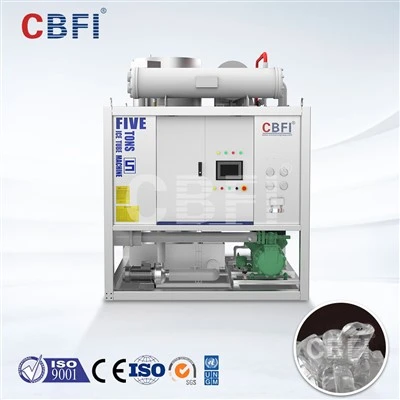


Market Insight: The Expanding "Ice Economy" Across Industries
1. Catering & Beverage Industry Transformation
With the rapid expansion of milk tea chains, fresh beverage stores, supermarkets, and seafood restaurants, traditional crushed ice is increasingly being replaced due to:
Fast melting rate
Hygiene control limitations
Unstable product consistency
Tube ice, with its hollow cylindrical structure, delivers:
Slower melting speed
Better cooling efficiency
No rapid dilution of beverages
Higher hygiene stability
For example, compared with crushed ice, tube ice can reduce beverage concentration loss from 5%–8% to below 2% within 30 minutes, significantly improving taste stability and customer experience.
2. Cold Chain Logistics: A Critical Temperature-Control Medium
The global cold chain logistics market has exceeded USD 400 billion, with rising demand for high-value transport including:
Fresh seafood and meat
Vaccines and biological materials
High-end agricultural products
Tube ice provides:
Stable cooling performance
High volume-to-weight efficiency
Reduced contamination risk compared to crushed ice
It has become a key supporting material in modern cold chain systems.
3. Emerging Industrial & Special Applications
Tube ice is also widely used in:
Large-scale events (sports, exhibitions, concerts)
Medical and laboratory sample transportation
Industrial high-temperature cooling processes (steel, electronics, chemical production)
Its uniform cooling structure ensures stable thermal control across diverse environments.
Why Choose a 30 Tons/Day Tube Ice Machine?
1. Large Capacity for Commercial Expansion
A 30-ton daily output system can support:
100+ medium-sized catering businesses
Multiple cold chain logistics fleets (8–10 vehicles daily ice supply)
Regional wholesale distribution networks
This capacity allows stable B2B supply chain integration.
2. Energy Efficiency & Cost Optimization
Modern CBFI tube ice systems integrate advanced energy-saving technologies:
Frequency conversion control system: saves up to 30% electricity consumption
Annual electricity cost reduction: approx. ¥150,000 (30T scale scenario)
Closed-loop water circulation system: water consumption reduced by 40%
Modular maintenance design: key components can be replaced within 3 minutes, reducing downtime to under 2 hours
3. Automation & Operational Stability
The system is designed for continuous industrial operation:
Fully automatic ice production cycle (water intake → freezing → ice dropping → storage)
Intelligent PLC control system for real-time monitoring
Multi-layer protection: overload, water shortage, ice full, pressure anomaly alerts
Industrial Ice Business Model: From Equipment to Revenue System
1. Customer Segmentation Strategy
B2B Core Markets:
Catering chains (milk tea, seafood restaurants, central kitchens)
Cold chain logistics companies (transport cooling support)
Food wholesale markets
Scenario Expansion:
Ice retail stores in commercial districts
On-demand ice rental for small businesses
Shared ice production service models
2. Site Selection Strategy
Recommended deployment environments:
Port and fishery processing zones
Logistics industrial parks
Food distribution hubs
Infrastructure requirements:
Stable industrial power supply (220V / 380V supported)
Continuous water source access
Cold storage or insulated ice warehouse system
3. Revenue Model Structure
Core Income:
Wholesale tube ice price: 5–8 RMB/kg (market dependent)
Logistics delivery service fees (distance/volume based)
Value-Added Services:
Equipment leasing model (from ~500 RMB/day)
Cold chain auxiliary equipment sales
Customized ice size production services
4. Investment & Profitability Overview
Equipment investment: ¥800,000 – ¥1,200,000
Annual depreciation: 6%–8%
Daily production: ~25 tons operational average
Monthly revenue (reference): ~¥450,000
Estimated net margin: 25%–35% under optimized operation
Launch Checklist: How To Start An Ice Production Business
Market Analysis
Evaluate regional demand across catering, logistics, and fisheries
Identify competitor pricing and distribution gaps
Equipment Selection
Compare at least 3 suppliers
Focus on energy efficiency, certification (CE/ISO), and service capability
Financial Planning
Explore installment purchase options
Apply for local industrial or green energy subsidies (if available)
Pilot Operation
Start with small-scale supply contracts
Optimize logistics and storage efficiency before scaling
Product Specification (TV300 – 30 Tons/Day Tube Ice Machine)
| Model | Daily Output | Compressor Power | Cooling Tower Fan Power | Cooling Pump Power | Dimensions (mm) | Weight |
|---|---|---|---|---|---|---|
| TV300 | 30 T/24h | 83.6 kW | 2.2 kW | 7.5 kW | 3100×2200×2500 | 7200 kg |
Conclusion
The 30 Tons Fully Automatic Tube Ice Machine is not just a production device-it is a commercial infrastructure for building scalable ice supply networks.
By combining automation, energy efficiency, and industrial-grade stability, it enables enterprises to transform ice production from a low-margin utility business into a structured, expandable revenue system across catering, logistics, and industrial markets.

Hot Tags: 30 Tons Fully Automatic Tube Ice Machine, China, manufacturer, factory, price, buy, ice tube maker machine, ice tube machine, 1 ton tube ice machine