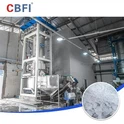

In the context of modern food industry, refrigeration technology is like silent blood, maintaining the quality of the entire process from the ocean to the dining table, from farmland to factories. Among them, the plate ice machine - this seemingly simple equipment, with its unique physical form and technical connotation, has become an indispensable cooling carrier in the food processing chain.
The cooling demand in the food processing field is far from being covered by a single model. The preservation of aquatic products requires sufficient contact between the ice body and the material and slow melting. Meat processing requires a stable and uniform low-temperature environment. Pre cooling of fruits and vegetables pursues a balance between rapid cooling and humidity maintenance. Cooling of baking, chemical and other auxiliary materials also requires the elimination of cross contamination. The diversification of this demand has put forward almost stringent requirements for ice making equipment: it needs to have stable production and high adaptability in terms of ice hardness, melting rate, and shape specifications.
The design of the CBFI plate ice machine allows for flexible adjustment of the thickness of the ice produced between 2mm and 20mm. Behind this seemingly simple parameter is a precise strategy for different scenarios. 2mm thin ice is like snowflakes, which can quickly cover the surface of seafood to form a "breathing film", effectively cooling down and avoiding cell damage; 15mm thick ice is suitable for cold storage buffering in meat processing centers, with a smoother melting curve; And 20mm thick ice provides long-term cooling support for chemical processes.
Breakthroughs in two key components of CBFI plate ice machine:
1. Super pressure resistant evaporator: the cornerstone of stability
The most vulnerable aspect of traditional ice making equipment often lies in the pressure bearing capacity of the evaporator. The enhanced evaporator used by CBFI has withstood a limit test of 90kg pressure, which is 45 times the normal operating pressure. This means that in long-term continuous operation, even in the face of extreme working conditions such as refrigerant pressure fluctuations and sudden temperature changes, the evaporator can still maintain structural integrity. The deeper value lies in the fact that this "over design" concept significantly reduces the failure rate of equipment caused by metal fatigue, increasing the average annual trouble free operation time to over 8000 hours, providing predictable production guarantees for food processing enterprises.
2. Patent hydraulic expansion and S-shaped flow channel: the password for uniform cooling
The bottleneck of refrigeration efficiency often lies not in the supply of cooling capacity, but in the balanced distribution of cooling capacity. The patented hydraulic expansion technology adopted by CBFI achieves molecular level bonding between the evaporator pipeline and the cooling surface through precise hydraulic control, eliminating the thermal resistance micro gaps in traditional processes. Combined with the unique S-shaped three-dimensional flow channel design, the refrigerant forms intelligent alternation between turbulence and laminar flow during the flow process, achieving a uniform temperature field with a surface temperature difference of no more than ± 0.3 ℃ on the evaporator. This almost perfect temperature distribution ensures consistent ice production efficiency per square centimeter, fundamentally eliminating traditional pain points such as uneven ice thickness and localized frosting.
The physical properties of "rapid ice making" and "dense anti melting" are inherently contradictory - rapid crystallization often forms a loose structure, while dense ice usually requires slow solidification. The CBFI plate ice machine achieves the unity of opposites through three innovations:
Firstly, the dual stage supercooling technology allows the refrigerant to reach a deep supercooling state before entering the evaporator, releasing a large amount of cold energy instantly upon contact with the heat exchange surface, reducing the core temperature of the water body to freezing point within 30 seconds. Secondly, the micro vibration demolding system applies high-frequency micro amplitude vibration at the critical point of icing, promoting the orderly growth of ice crystals in the vertical direction and forming a dense columnar crystal structure.
Finally, the nano scale ice repellent coating on the surface of the evaporator not only reduces the adhesion of the ice body for easy demolding, but also forms a smooth mirror like ice surface, reducing the air contact area by 40% and significantly delaying the melting process.
The combination of this technology produces plate ice with a hardness of 92-95SHA and a melting time that is 1.8 times longer than ordinary sheet ice. In seafood preservation tests, the freshness index (K value) of salmon remains at a high level within 48 hours.
In the field of aquaculture, its 2mm thin ice can perfectly wrap each shrimp, achieving precise temperature management from -1 ℃ to 0 ℃; In the central kitchen system, adjustable medium thick ice and vegetable cleaning lines are linked to achieve integrated pre cooling and preservation operations; In the baking factory, dry ice of a specific thickness is mixed with flour in a spiral conveyor to solve the problem of temperature control during summer dough fermentation; Even in the field of biopharmaceuticals, the sterile ice produced has become a key medium for cooling culture media. The continuous expansion of application boundaries confirms the core value of excellent industrial equipment - not only solving existing problems, but also opening up new possibilities.
https://www.icemachinesource.com/plate-ice-machine/
If you are interested in more details about this product,please contact with
E-mail:cbfi@icemakerchina.com
Mobile: +86-18929552761 (WhatsApp/ WeChat)