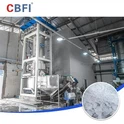

In recent years, with the explosive growth of cold chain demand, the challenges faced by traditional ice making plants have become increasingly prominent: rising labor costs, high energy consumption, uneven product quality, and frequent fluctuations in production capacity caused by sudden equipment failures. CBFI automated ice making plant technology introduces intelligent manufacturing systems, industrial Internet of Things (IIoT), and modular design.
Production process comparison: from manual led to full process intelligence
1.1 Pain points of traditional ice factory production mode
Traditional ice factories usually rely on manual operations, from raw material (such as salt water, water circulation) proportioning, mold filling, cooling to finished product demolding, all of which require a large amount of manual participation:
High labor intensity: Workers need to work continuously in low temperature and high humidity environments, which is labor-intensive and inefficient.
• Quality control instability: Human operation differences may lead to density and size deviations of ice cubes, and even cause impurities to mix in.
Strong equipment dependence: Old production lines lack real-time monitoring capabilities, and equipment failures often lead to the shutdown of the entire production line.
1.2 Breakthrough in CBFI Automated Ice Factory
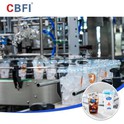
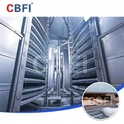
CBFI has achieved full chain automation from raw material processing to finished product packaging through an intelligent production line integration system
Unmanned operation unit: using industrial robots to grasp molds, combined with intelligent filling devices (accuracy ± 2%), reducing manual intervention by more than 90%.
• Closed loop quality control: Built in spectral sensor and pressure feedback system, real-time monitoring of ice density and thickness parameters, automatically triggering correction when deviation exceeds threshold.
Flexible production architecture: The modular design of the production line supports quick switching of ice cube sizes (5kg to 20kg), adapting to different scenarios such as aquaculture and logistics.
Management dimension upgrade: from extensive management to digital twin driven
2.1 Management Challenges of Traditional Ice Plants
Traditional ice factory managers often face challenges of information lag and resource mismatch:
• Out of control energy consumption: Equipment such as refrigeration units and water pumps lack intelligent regulation, resulting in serious energy waste.
• Inefficient inventory: Manual recording of warehouse data is prone to errors, and insufficient ice turnover leads to the coexistence of "ice accumulation" or "out of stock".
• Delayed fault response: Relying on manual inspection to discover equipment abnormalities, maintenance costs account for more than 30% of the operating budget.
2.2 CBFI's Digital Solutions
CBFI has built an intelligent management center through an industrial Internet of Things platform and digital twin technology
Energy dynamic optimization: The system adjusts the operating power of the refrigeration unit based on real-time loads (such as external temperature and order volume), saving 25% -35% energy compared to traditional modes.
Warehouse automation management: AGV robots cooperate with three-dimensional shelves to achieve "goods to people" picking, increasing inventory accuracy to 99.8% and outbound efficiency by 40%.
Predictive maintenance: By relying on vibration sensors, potential faults such as bearing wear and circuit aging can be alerted 72 hours in advance, reducing unplanned downtime by 80%.
CBFI Core Technology
3.1 Core Patent Technology: Intelligent Circulating Water Treatment System
The water circulation system of traditional ice plants is prone to deterioration of ice quality due to impurity precipitation. CBFI has achieved breakthroughs through two technologies:
Ion adsorption filtration module: Utilizing nanoscale porous media to adsorb calcium and magnesium ions, reducing water hardness to below 50ppm and minimizing mold scale deposition.
• Waste heat recovery device: The waste heat generated during the ice making process (about 20%) is introduced into the pre cooling process, increasing the overall thermal energy utilization rate to 78%.
3.2 Combination of SCADA system and edge computing
CBFI's Distributed Control System (SCADA) adopts a "cloud+edge" architecture to ensure low latency response:
Edge nodes process local sensor data (such as temperature and pressure) in real-time, reducing decision latency to within 50ms.
The cloud platform stores historical data and continuously optimizes production parameters through machine learning (ML) to form an adaptive optimization model.
Technical advantages: Compared to pure cloud solutions, response speed is increased by 30 times and data transmission costs are reduced by 50%.
Social benefits and industry value extension
1. Environmental benefits
The energy-saving technology of automated ice plants can significantly reduce their carbon footprint. Taking a factory with an annual output of 100000 tons of ice as an example:
The CBFI system can save approximately 4.8 million kilowatt hours of electricity annually, equivalent to reducing 3200 tons of CO ₂ emissions.
The water circulation system reduces the water consumption per ton of ice to 0.8 tons, saving 35% of water compared to traditional processes.
2. Promote industrial chain collaboration
The modular design of CBFI provides an upgrade path for small and medium-sized ice plants:
Lightweight solution: Customizable production lines with a daily capacity of 100-2000 tons, suitable for the needs of small and medium-sized aquatic markets and logistics enterprises.
The rise of automated ice factories, from relying on human labor to being driven by intelligence, is not only an improvement in efficiency, but also an important pivot for the sustainable development of the industry. CBFI, with technological innovation as its core, has set a benchmark for the transformation of the refrigeration industry through cost reduction, efficiency improvement, green energy conservation, and intelligent management. In the future, as more enterprises embrace automation, ice factories will no longer be just "ice making factories", but will become indispensable intelligent nodes in the cold chain logistics ecosystem.