

In today's booming construction industry, the widespread use of concrete has made it the cornerstone of modern engineering. However, with global climate change and the frequent occurrence of extreme weather, concrete construction in high-temperature environments is facing unprecedented challenges. In many large-scale construction projects, construction workers often find that even after carefully proportioned concrete is poured, problems such as surface cracking and insufficient strength may still occur. These 'invisible killers' often stem from a key reaction inside concrete - the accumulation and release of hydration heat.
Hydration heat: the root cause of concrete cracks
The hardening process of concrete relies on the chemical reaction between cement and water, known as hydration reaction. This process generates a large amount of heat, known as "hydration heat". At room temperature, this heat can usually dissipate naturally, but in high-temperature environments, the problem becomes prominent.
Specific manifestation: When the ambient temperature exceeds 30 ℃, the hydration rate of cement accelerates, leading to a rapid increase in internal temperature. Experimental data shows that the internal temperature of uncooled concrete may reach over 70 ℃, and the temperature difference with the outside can exceed 40 ℃. This temperature gradient will generate significant thermal stress inside the concrete, accompanied by material shrinkage. Once the stress exceeds the tensile strength of concrete, cracks are inevitably generated.
Consequence impact: Cracks not only affect the durability of the structure, but may also reduce impermeability, accelerate internal steel corrosion, and shorten the service life of the project.
The limitations of traditional cooling methods
For a long time, construction teams have tried various cooling methods, but most of them have obvious defects:
1. Cold water cooling method: By adding low-temperature water to the aggregate or mixing water to lower the initial temperature, excessive dilution may weaken the activity of the cement and affect its strength.
2. Night construction: relies on natural cooling, but is difficult to implement due to weather and schedule limitations, especially during periods of sustained high temperatures.
3. Manual addition of ice cubes: Although it can directly cool down, the distribution of ice cubes is uneven, the melting speed is uncontrollable, and the efficiency of manual operation is low, which can easily introduce impurities.
CBFI Intelligent Ice Making and Supply System: Technological Breakthrough and Engineering Practice
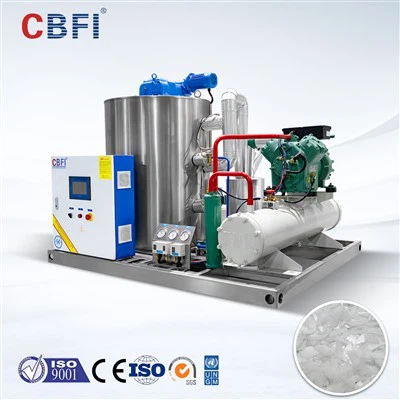
In response to the above pain points, CBFI Ice Spring Refrigeration has launched an "automatic ice making, ice storage, and ice supply integrated rake ice system", which provides innovative solutions for high-temperature construction through technological integration and intelligent control.
Core design principles:
· Intelligent ice making module: Equipped with an efficient refrigeration compressor unit and an intelligent temperature control system, it can produce standardized ice cubes as needed. The size and density of ice cubes can be adjusted to meet different aggregate requirements.
· Dynamic ice storage technology: The ice storage bin is equipped with a circulating ventilation system to avoid ice flake adhesion and ensure smooth retrieval. At the same time, the insulation layer design reduces heat infiltration and lowers energy consumption.
· Automated ice supply system: Real time monitoring of concrete mixture temperature through sensors, automatic regulation of ice supply volume. The ice supply machine is linked with the mixing equipment to ensure that the ice cubes are evenly distributed in the aggregate, avoiding local supercooling or clumping.
· Intelligent control of ice scraper: The ice scraper device imitates the manual "ice breaking" action, accurately crushes large flake of ice through a robotic arm, ensures that ice particles and aggregates are fully mixed, and improves cooling efficiency.
Analysis of Technical Advantages:
· Accurate temperature control: Actual test data shows that the system can reduce the initial temperature of concrete by 5-8 ℃, control the maximum internal temperature difference within 25 ℃, and reduce the occurrence rate of cracks by more than 80%.
· Efficiency improvement: Automated processes reduce manual intervention, resulting in a 40% increase in single mixing efficiency, especially suitable for large commercial mixing stations.
· Cost optimization: Modular design is compatible with existing equipment, and initial investment is gradually recovered by reducing rework and material loss.
The technical value of CBFI system is not only reflected in the optimization of a single link, but also promotes a systematic change in concrete construction:
1. Intelligent management: After integrating the Internet of Things module, the construction party can remotely monitor data such as ice inventory and mixing temperature, achieving "preventive maintenance".
2. Multi scenario applicability: In addition to high-temperature environments, this system can also be used for complex scenarios such as winter construction antifreeze and underground space ultra long structure construction.
3. Sustainable development: Compared with traditional cooling methods, it reduces carbon emissions by 15%, which meets the low-carbon transformation needs of the global construction industry.
The challenge of concrete cooling engineering is essentially the combination of materials science and engineering management. The CBFI system, through technological innovation, transforms the previously passive "cooling problem" into a precisely controllable "temperature management". This transition from experience driven to data-driven is not only an upgrade in concrete construction technology, but also a demonstration of wisdom and responsibility in the construction industry's response to climate change.
Hot Tags: temperature control challenges and intelligent solutions for concrete construction in high-temperature environments, China, manufacturer, factory, price, buy, 5 ton flake ice machine, ice flake making machine, flake ice machine, flake ice machine for fish, commercial ice flake machine