
Pearl taro balls have become a hot selling product in the baking, dessert, and frozen food industries due to their delicate taste and rich nutritional value. However, a long-standing challenge in its processing - the problem of adhesion and clumping in the quick freezing stage - severely restricts the scale production of enterprises. In the traditional quick freezing process, pearl taro balls are prone to adhesion due to high moisture content and smooth surface. They are easily squeezed and stacked in low temperature environments, which not only reduces the yield of finished products but also increases manual sorting costs. According to industry data, the loss of raw materials caused by adhesion problems can reach 5% -8%, seriously dragging down corporate profits.
Root analysis of frozen adhesion of pearl taro balls
To solve the problem of adhesion, we need to start from its causes. The main raw materials for pearl taro balls are taro, cassava starch, and sugar. They have a soft texture and a high moisture content (usually above 60%). In the traditional quick freezing process, there are the following core issues:
1. Uneven feeding leads to accumulation: Traditional conveyor belt feeding often causes local accumulation of taro balls during transportation due to uneven pressure or operational errors, resulting in physical adhesion.
2. Low fabric dispersion efficiency: Conventional fabric equipment cannot accurately control the spacing between materials, resulting in dense arrangement of taro balls and excessive contact surface before quick freezing.
3. Sudden temperature drop in quick freezing environment: Traditional quick freezing equipment uses forced air cooling or liquid nitrogen rapid freezing. Although the cooling rate is fast, uneven airflow can cause temperature fluctuations in local areas, leading to surface moisture condensation and further exacerbating the risk of adhesion.
These issues are compounded, requiring additional manual screening of the finished product, which not only increases labor costs but may also lead to complaints from end customers due to incomplete sorting.
CBFI fluidized freezing production line: advantages of step-by-step deconstruction technology
(1) Elevator: precise feeding, eliminating the risk of accumulation from the source
The lifting machine of the CBFI system adopts a double helix pushing structure, which monitors the material flow in real time through sensors and adjusts the conveying speed in combination with a variable frequency motor. Compared to traditional chain hoists, its advantages are reflected in:
Flexible feeding: The spacing between the spiral blades can be fine tuned to ensure that a single taro grain is fed in, avoiding jamming or squeezing.
Shock absorption design: An airbag buffer layer is added at the bottom to reduce the damage caused by material impact.
(2) Fabric machine: 3D spreading technology achieves "zero contact" arrangement
Traditional fabric equipment often relies on rollers or vibration platforms, while CBFI fabric machines innovatively adopt airflow pulse+mechanical arm collaborative control. Specific technical highlights include:
1. Intelligent zoning fabric: Through camera visual recognition, the conveyor belt is divided into 200 independent areas, with only 1-2 taro balls allowed to fall into each area.
2. Airflow assisted dispersion: The bottom microporous airflow device generates directional vortices, slightly lifting the material to ensure that the taro balls naturally separate and fall in the air.
3. Adjustable spreading angle: According to the diameter of taro balls (such as regular 8mm or special 12mm), the fabric slope is automatically adjusted to make the material "pearl like" single-layer spreading.
(3) Fluidized freezer: a combination of dynamic suspension and uniform refrigeration with dual effects
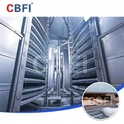
The core component of CBFI is its patented fluidized bed quick freezing system, which utilizes airflow to suspend materials in a low-temperature environment, achieving stack free quick freezing. The specific operational process is as follows:
1. Pre cooling zone (-10 ℃): Utilize circulating cold air to initially reduce the surface temperature of taro balls and minimize water evaporation before entering the main freezer.
2. Suspended freezer (-35 ℃): The bottom is covered with dense air holes, and high-pressure cold air flows upward at a speed of 0.5m/s to lift the taro balls in a "suspended" state. At the same time, cold air around them forms a convective field to ensure that each individual is exposed to low-temperature airflow.
3. Dynamic adjustment system: The built-in temperature humidity sensor collects 30 sets of data per second, automatically adjusting the airflow intensity and freezer temperature to avoid local temperatures being too high or too low.
Compared to traditional flat freezing machines, this system shortens the freezing time to 18 minutes (traditional takes 35 minutes), and the finished product has no ice crystals on the surface, complete internal cell structure, and a 15% increase in Q elasticity after reheating.
Technical Comparison: Efficiency Gap between CBFI and Traditional Processes
| Indicator | Traditional quick freezing process | CBFI fluidized bed quick freezing production line |
| Single line production capacity (kg/h) | 300-400 | 800-1200 (increased by over 200%) |
| Finished product qualification rate | 78% -82% (adhesion causes loss of 7% -10%) | 98.5%+(adhesion rate<0.5%) |
| Energy consumption (kW/ton) | 280-320 | 190-210 (saving 30% energy) |
| Manual sorting cost | 2-3 working hours per ton | Almost no sorting required |