
The pain points of preservation in the seafood processing industry and the limitations of traditional solutions
The global market size of the seafood processing industry continues to grow, but the core challenge always revolves around "preservation". If fresh caught seafood is not cooled down in a timely manner within 2-4 hours after fishing, microbial reproduction and enzymatic reactions will lead to a rapid decline in quality, ultimately resulting in a loss rate of up to 30% -40% (FAO 2024 data). Although traditional preservation methods such as dry ice, crushed ice, or cold water soaking are low-cost, they have the following problems:
1. Insufficient cooling efficiency: Crushed ice requires prolonged contact with the fish body to reach the core temperature (usually 6-8 hours), leading to muscle tissue stiffness and increased dehydration rate.
2. Imbalance in temperature control: Although dry ice can rapidly cool, the release of carbon dioxide during sublimation may cause fish meat to spoil, and the operation is complex.
3. Risk of ice melting pollution: Traditional ice melts to form water bodies, which can easily mix with pathogens such as Salmonella, increasing food safety hazards.
Therefore, the industry urgently needs a solution that can achieve precise temperature control, rapid cooling, and balance hygiene and efficiency.
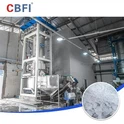
CBFI integrated tube ice machine
(1) The physical characteristics and advantages of ice pipes
1. Three dimensional structure design:
The ice tube is hollow cylindrical in shape (with a diameter of about 15mm and a length of 30-50mm), with a surface contact area that is 300% larger than traditional ice cubes. At the same time, the internal cavity forms a "cold air circulation channel". This structure enables it to quickly transfer low temperatures through a "conduction convection" dual mode when in contact with fish bodies, increasing the cooling rate by four times compared to traditional crushed ice.
2. Melt resistance and temperature stability:
Experimental data shows that the complete melting time of tube ice at room temperature (25 ℃) exceeds 12 hours, which is 40% longer than that of ordinary ice cubes. The core mechanism is that the hollow structure delays the heat exchange rate between the ice surface and the environment, while maintaining a stable medium temperature in the range of -1 ℃ to 0 ℃. This slight temperature difference environment can effectively inhibit protein denaturation and reduce water loss in fish meat (reducing the water loss rate to below 3%).
(2) System integration and production process optimization
CBFI equipment integrates three major modules: automatic cleaning, circulating water treatment, and remote temperature control
Intelligent module linkage: After the fishing boat unloads, the ice pipe machine monitors the temperature of the fish compartment in real time through sensors and automatically adjusts the ice making rate.
Hygiene level certification: All pipelines and contact surfaces are made of medical grade 316 stainless steel, which complies with FDA and EU HACCP standards.
Space adaptation design: The modular body can be flexibly embedded into the processing line, with a minimum footprint of only 4.5m ², compatible with small and medium-sized processing plants.
The deep value of ice preservation technology for the industrial chain
(1) Economic Enhancement: Comprehensive Optimization from Cost to Benefit
1. Direct cost savings:
The high melting resistance of tube ice reduces the amount of ice required for each batch of preservation by 30%. Calculated based on an average daily production capacity of 15 tons, the annual cost savings of ice consumption are approximately $48000.
2. Indirect revenue growth:
The product shelf life has been extended to 72 hours (traditional methods only take 48 hours) to meet the needs of remote transportation.
Due to quality improvement, the premium in the high-end market can reach 15% -20%.
(2) Environmental Dimension: Practical Path of Low Carbon Fisheries
Resource recycling: The cooling water of the tube ice machine can be reused after purification, reducing water consumption by 60%.
• Carbon footprint reduction: Compared to traditional ice crushing processes, the carbon emissions per unit product are reduced by 28% (based on LCA analysis).


https://www.icemachinesource.com/products
If you are interested in more details about this product,please contact with
E-mail:cbfi@icemakerchina.com
Mobile: +86-18929552761 (WhatsApp/ WeChat)