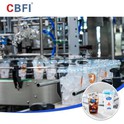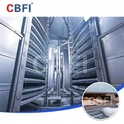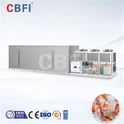

In the process of food industrialization, freezing technology has always been a key factor affecting product competitiveness. The rapid freezing and preservation of baked goods and pre made dishes face a dual challenge: to preserve the original flavor and taste of the ingredients while achieving efficiency balance in large-scale production. Traditional quick freezing machines often suffer from "ice crystal damage" due to slow freezing speed and large temperature fluctuations, which not only results in rough product texture but also affects the consumption experience after reheating. The CBFI tunnel type intelligent quick freezing system reduces the freezing time to one-third of traditional processes, while controlling the phase loss rate within 1%, providing a new solution for the food industry.
Technical pain points and limitations of traditional quick freezing processes
1.1 Quality loss caused by slow freezing in cold chain
Ice crystal effect: Traditional quick freezing machines usually use air direct blowing technology below -30 ℃, with a freezing rate of only 0.5 ℃/min. Moisture forms large ice crystals in the intercellular spaces, damaging the crispy structure of baked products or the fibrous tissue of pre made vegetables.
Uneven temperature field: The open cold air circulation can cause a temperature difference of up to ± 5 ℃ inside the tunnel. For example, a certain bread factory once caused a "frost layer" problem due to local supercooling, with a cracking rate of up to 15% on the bread skin.
Energy consumption and space contradiction: In order to extend the freezing time, traditional equipment needs to design ultra long tunnels. The quick freezing line of a central kitchen occupies an area of 200 square meters, but the daily production capacity is only 12 tons.
1.2 Technical challenges arising from differences in food characteristics
Baking products (such as bread and cakes): sensitive to "freezing stress", rapid cooling should avoid the phenomenon of "semi freezing" where the surface freezes but the interior is not fully frozen.
Pre made dishes (such as dumplings, coated chicken nuggets): It is necessary to take into account the synchronization of freezing between the center and surface of the ingredients, otherwise there may be external burning and internal growth or juice loss after reheating.
Three core technological breakthroughs in CBFI tunnel quick freezing system
1. Intelligent layered freezing technology
Multi level temperature control cabin design: Divide the tunnel into 3-5 independent temperature control zones, each cabin equipped with an independent variable frequency compressor and PID controller.
Adaptive airflow distribution system: adopting a biomimetic fluid dynamics model, combining vortex airflow with directional injection to avoid direct impact on the product surface.
2. Microchannel phase change cold storage technology
Application of phase change materials: Embedding paraffin based composite materials on the surface of the evaporator to form a dynamic heat capacity buffer layer.
Advantages: When the product passes through, the phase change material can absorb instantaneous heat load fluctuations, controlling the temperature difference inside the tunnel within ± 0.5 ℃, which is 10 times more stable than traditional systems.
Energy saving closed-loop system: Combined with waste heat recovery technology, the condensation heat is introduced into the pre cooling section, reducing overall energy consumption by 28%.
3. Intelligent quality control and fault warning system
Digital twin diagnosis platform: Build virtual models of equipment, predict compressor and fan faults through parameters such as vibration and current, and improve maintenance response speed by 70%.
The success of CBFI tunnel freezer lies not only in the breakthrough of technical parameters, but also in its profound insight into the essential needs of the food industry - finding a balance between industrial efficiency and product quality. With consumers' increasingly stringent requirements for the freshness of pre made dishes and the resilience of baked goods, tunnel style quick freezing systems are becoming a key springboard for food factories to move from "scale production" to "quality manufacturing". In the future, with the deep integration of AI quality inspection and blockchain traceability, frozen technology may redefine the "last mile" value of cold chain logistics.