

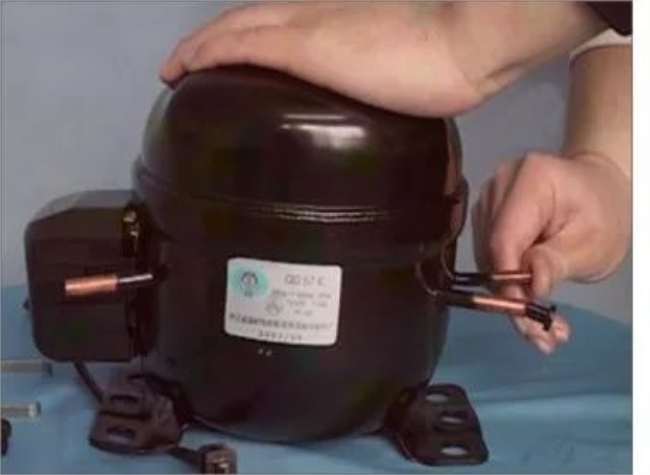
1. Inspection method for compressor suction and exhaust energy
First, remove the compressor, power it up, plug the exhaust hole of the compressor with your finger for a moment, and then remove your finger. Because there is pressure in the compressor, when you block the exhaust hole of the compressor with your hand, you should feel the exhaust pressure, and when you remove your finger, you can hear the exhaust sound, and the compressor with normal exhaust pressure should be difficult to block the gas discharged from the compressor, which indicates that the compressor has good performance.
If you don't feel the pressure when you block the exhaust pipe with your hand, and you can't hear the exhaust sound when you remove your fingers, the compressor is not performing well. The suction performance check is similar to the exhaust, the operation method, press and hold the suction tube with your finger, if you feel the suction pressure, it means that the compressor is normal. If you don't feel any suction when you remove your fingers, the compressor doesn't have the ability to suction.
2. Judge the short circuit of the motor winding of the compressor
Use a multimeter to select R×1 gear, and measure the resistance value of C-R or C-S of the compressor motor winding after zeroing. If the resistance value of the measured winding is less than the normal value, it can be judged that the winding is short-circuited. For a three-phase motor, if two of the three gauges are used to contact two of the three terminal post terminals, if the resistance value measured three times is the same, it means that the winding is good, if the resistance value measured twice is infinity, it means that there is one group of windings open, if the three tests are infinite, it means that there are at least two sets of winding open, if the resistance value measured in 2 of the 3 measurements is significantly smaller than that measured in the other time, it indicates that there is a short circuit.
3. Judge that the compressor motor touches the shell and the ground
When the compressor motor hits the shell, the insulation layer of the internal wiring of the winding wire is damaged and collides with the compressor shell, forming a short circuit. If this fault occurs, the fuse will blow and the compressor motor will not run. Check the method of touching the shell to the ground, and you can also use the resistance file of the multimeter.
Adjust the zero first, then put one pen firmly against the common point, and the other pen on the compressor process tube to expose the metal part, or remove a small piece of the patent leather of the housing plate for measurement. If the resistance value is very small, it can be judged that the winding or internal wiring is touching the shell and ground.
Fourth, the compressor cylinder
Compressor jamming means that the shaft of the compressor is stuck, and the compressor cannot rotate at this time. The reason for the compressor to jam the cylinder is that the refrigeration oil cannot come up, which makes the lubrication insufficient and the friction increases, or there are dust and impurities in the pipeline, which causes the moving surface to be stuck, or the compressor is stuck due to pure mechanical failure.
When the press is activated, the hammer strikes three solder joints on its body. But pay attention to the Tao, and don't knock it out of shape. Gently knock on the compressor shell, loosen the stuck part slightly, sometimes start the operation or increase the power supply voltage by 10%, and start the impact multiple times, this method can solve the phenomenon of insufficient lubrication of the cylinder, especially effective for rotary compressors.
5. Judgment method of compressor winding
The ohmic level of the multimeter measures the resistance between every two points, the two points with the largest resistance value are the starting and running windings, and the remaining point is the common point. Then connect the two measured points with the common end respectively, the larger resistance is the starting winding, and the smaller one is the running winding.
The resistance relationship between the three points is: run and start = run and common end + start and public end.
Use a multimeter to detect the resistance between the starting end and the common end---- the resistance value is large.
Use a multimeter to detect the resistance between the running end and the common side---- the resistance value is small.
Use a multimeter to detect the resistance between the starting and running ends, which is equal to the sum of the resistance values of the previous two measurements. If the detected value is infinity or infinitesimal small, it indicates a short circuit or open circuit fault between the windings.