
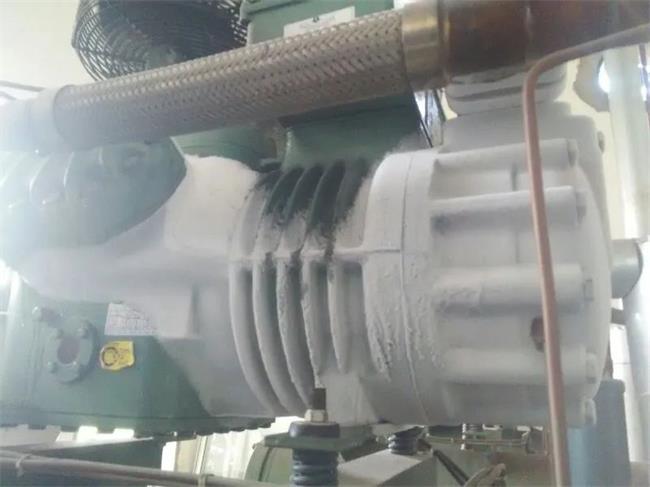
1. Frosting at the return port of the compressor
Frosting at the return port of the compressor indicates that the temperature of the compressor return gas is too low, and we all know that if the refrigerant of the same quality changes the volume and pressure, the temperature will have different performance, that is, if the liquid refrigerant absorbs more heat, then the same quality of refrigerant will perform high pressure, temperature and volume, and if the heat absorption is less, the pressure, temperature and volume will be low.
That is to say, if the return gas temperature of the compressor is low, it will generally show low return pressure and high amount of refrigerant of the same volume at the same time, and the root cause of this situation is that the refrigerant flowing through the evaporator cannot completely absorb the heat required for its own expansion to the predetermined pressure and temperature value, resulting in a relatively low temperature, pressure and volume value of the return air.
There are two reasons for this problem:
1. The supply of liquid refrigerant to the throttle valve is normal, but the evaporator cannot absorb heat normally and supply the refrigerant to expand.
2. The evaporator absorbs heat normally, but the supply of refrigerant to the throttle valve is too much, that is, the refrigerant flow is too much, which we usually understand as too much fluorine, that is to say, more fluorine will also cause low pressure.
Second, due to the lack of fluorine, the compressor return gas frosts
1. Due to the small flow of refrigerant, the first expandable space of the refrigerant will begin to expand after the refrigerant flows out of the back end of the throttle valve, and most of us see that the frosting of the separator head at the back end of the expansion valve is often caused by the lack of fluorine or the insufficient flow of the expansion valve, too little refrigerant expansion will not use all the evaporator area, and will only form a low temperature in the evaporator locally.
After local frosting, due to the formation of a thermal insulation layer on the surface of the evaporator and the low heat exchange in this area, the refrigerant expansion will be transferred to other areas, and the whole evaporator will gradually frost or freeze, and the entire evaporator will form a thermal insulation layer, so the expansion will spread to the compressor return air pipe and cause the compressor return air frosting.
2. Due to the small amount of refrigerant, the evaporation temperature is low due to the low evaporation pressure of the evaporator, which will gradually lead to the condensation of the evaporator to form a thermal insulation layer and transfer the expansion point to the compressor return air to cause the compressor return air frosting. Both of the above points will show evaporator frosting before the compressor return gas frosts.
In fact, in most cases, for the frosting phenomenon, as long as the hot gas bypass valve is adjusted, the specific method is to open the rear end cover of the hot gas bypass valve, and then use the No. 8 hexagon wrench to turn the adjustment nut clockwise, the adjustment process should not be too fast, generally pause about half a turn, let the system run for a period of time to see the frosting situation and then decide whether to continue to adjust. Wait until the operation is stable and the frosting of the compressor disappears before tightening the end cap.
For models below 15 cubic meters, since there is no hot gas bypass valve, if the frost phenomenon is serious, the starting pressure of the condensing fan pressure switch can be appropriately increased. The specific method is to find the pressure switch first, remove the adjustment nut of the pressure switch to fix the small piece, and then rotate clockwise with a Phillips screwdriver.
3. Frosting of cylinder head (frosting of crankcase in severe cases)
Cylinder head frosting is caused by large amounts of wet steam or refrigerant sucked into the compressor. The main reasons for this are:
1. The opening of the thermodynamic expansion valve is adjusted too large, and the temperature sensing bag is installed incorrectly or the fixation is loose, so that the temperature is too high and the valve core is opened abnormally. The thermostatic expansion valve is a direct-acting proportional regulator that uses the superheat at the outlet of the evaporator as a feedback signal, and compares it with a given superheat value to generate a deviation signal to regulate the flow of refrigerant entering the evaporator, which integrates the transmitter, regulator and actuator.
According to the different balance methods, the thermostatic expansion valve can be divided into two types: the internal balance thermostatic expansion valve and the external balanced thermostatic expansion valve. The liquid refrigerant evaporates in the evaporator and absorbs heat, and when it flows to the outlet of the evaporator, it has been completely vaporized and has a certain amount of superheat. The thermostatic expansion valve's thermostat cylinder is attached to the evaporator outlet line and the temperature at the evaporator outlet is felt. If the liquid in the thermostat is the same as the refrigerant, the liquid pressure above the diaphragm of the thermostatic expansion valve is greater than the liquid pressure below the diaphragm, and the higher the temperature at the outlet of the evaporator, that is, the greater the superheat, the greater the liquid pressure above the diaphragm.
This pressure difference is balanced by the tension of the ejector rod and the adjustment spring under the diaphragm. If you change the tension of the adjusting spring, you can change the upper ejector force of the ejector rod and thus change the opening of the needle valve. Obviously, the superheat of the evaporator can also lead to a change in the opening of the needle valve. When the adjusting spring is adjusted in a certain position, the expansion valve will automatically change the opening of the needle valve according to the temperature of the evaporator outlet, so that the superheat of the evaporator outlet is maintained at a certain value.
The opening of the thermostatic expansion valve is adjusted too large, and the temperature sensing package is installed incorrectly or loosely fixed, so that the temperature is too high and the valve core is opened abnormally, so that a large amount of wet steam is sucked into the compressor and the cylinder head is frosted. The thermostatic expansion valve is used in conjunction with the adjustment of the superheat when the evaporator is working.
If the superheat of the evaporator outlet is too large, the superheating section at the rear of the evaporator is too long, and the refrigeration capacity will be significantly reduced; If the outlet superheat is too small, it may cause compressor liquid shock or even cylinder head frosting. It is generally believed that the expansion valve should be adjusted to the outlet of the evaporator and the working superheat should be 3 °C ~ 8 °C.
2. The leakage of the solenoid valve for liquid supply or the failure to close the expansion valve when shutting down causes a large amount of refrigerant liquid to accumulate in the evaporator before starting. The temperature relay is used in conjunction with a solenoid valve to control the storage temperature.
When the temperature of the cold storage is higher than the upper limit of the starting value, the temperature relay contact is turned on, the solenoid valve coil is energized, the valve is opened, and the refrigerant enters the evaporator for cooling; When the storage temperature is lower than the lower limit of its set value, the temperature relay contact is disconnected, the solenoid valve coil current is cut off, the solenoid valve is closed, and the refrigerant stops entering the evaporator, so that the storage temperature can be controlled within the required range.
3. When starting the compressor, the suction shut-off valve is opened too large or too early.
4. When there is too much refrigerant in the system, the liquid level in the condenser is higher, the condensation heat exchange area is reduced, and the condensation pressure increases, that is, the pressure in front of the expansion valve increases, and the refrigeration dose flowing into the evaporator increases, and the liquid refrigerant cannot completely evaporate in the evaporator, so the compressor sucks in wet steam, the cylinder is cold or even frosty, and may cause "liquid shock", and the evaporation pressure will also be high.