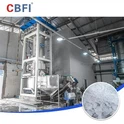

In the fields of food processing, medical or commercial ice making, flake ice machines are indispensable production equipment. However, many operators may not be aware that the cleanliness of the condenser fins directly affects the cooling efficiency, energy consumption, and service life of the equipment. According to statistics, failures caused by the accumulation of dust or dirt in the condenser not being cleaned in a timely manner account for more than 35% of the maintenance cases of the flake ice machine. Therefore, mastering the correct cleaning methods and establishing standardized maintenance procedures are the core links to ensure the stable operation of equipment.
Why clean the condenser fins?
The fins of the condenser are key components of the heat exchange system of the flake ice machine, and their function is to dissipate the heat of the refrigerant to the external environment. If dust, oil, or foreign matter accumulates on the surface of the fins for a long time, it will form a thermal insulation layer, leading to:
1. Decreased refrigeration efficiency: The heat dissipation capacity is weakened, and the compressor needs to operate for a long time to maintain the refrigeration effect, directly increasing energy consumption.
2. Accelerated component wear: High load operation will exacerbate the wear and tear of components such as compressors and fans, shortening equipment lifespan.
3. Unstable ice quality: When the cooling capacity is insufficient, the ice sheet may have uneven thickness, clumping, and other problems, affecting the user experience.
4. Safety hazards: Severe dust accumulation may cause local overheating, posing a risk of circuit short circuit or fire.
Therefore, regular cleaning of condenser fins is not only a necessary means to maintain equipment performance, but also a basic requirement for safe production.
Preparation before cleaning
1. Safe shutdown and power-off
It is necessary to unplug the power plug or turn off the main switch after the equipment is completely shut down to avoid the risk of electric shock. If it is a large commercial equipment, it is necessary to wait for at least 15 minutes after power failure to ensure stable internal pressure before operation.
2. Preparation of tools and materials
• Soft bristled brush/long handled brush: used to remove large particles of dust and loose dirt on the surface.
• Fin comb (aluminum special tool): restore the parallel arrangement of fins to prevent airflow obstruction caused by deformation.
• Neutral cleaning agent: Avoid using strong acids, strong bases, or chlorine containing solvents. It is recommended to choose specialized condenser cleaning agents (such as biodegradable descaling agents).
• High pressure spray gun or water bucket: If deep cleaning is required, a spray gun with a pressure of ≤ 4MPa can be used, but the circuit interface should be avoided.
• Protective equipment: gloves, goggles, masks (to prevent inhalation of dust or chemicals).
3. Check the environmental conditions
• Outdoor equipment should avoid rainy or high humidity environments to prevent rapid rusting of fins after cleaning.
• Indoor equipment needs to ensure good ventilation to avoid the retention of volatile gases from chemicals.
Detailed explanation of step-by-step cleaning process
Step 1: Preliminary cleaning of visible dirt
• Use a long handled soft bristled brush to gently sweep along the direction of the fin arrangement to remove surface dust, willow catkins, or adhered small insect corpses.
• If oil stains are found, they can be wiped with a dry cloth first, or partially wiped with a small amount of neutral cleaning agent to avoid expanding the contaminated area.
Step 2: Targeted cleaning of stubborn dirt
• Treatment of scale or hard stains:
Dilute the specialized cleaning agent with water at a ratio of 1:10, wet it with a soft bristled brush, gently brush the stain, and let it stand for 5-10 minutes to allow the chemical agent to decompose and crystallize. Stubborn scale can be extended to 15 minutes, but prolonged contact with metal surfaces should be avoided.
• Oil pollution treatment:
Use a cleaning agent containing surfactants to break down the oil film in a "spot coating+light brushing" manner. Be careful not to let cleaning agents flow into the internal pipes of the condenser.
Step 3: Fin reset and shaping
• After cleaning, use a fin comb to slowly comb from top to bottom to ensure that each fin returns to its original parallel state. Severely deformed fins may require professional tools for calibration. Do not forcefully bend them to avoid breakage.
Step 4: Rinse and Dry
• Rinse the residual cleaning agent with clean water or low-pressure water flow, with the water flow direction consistent with the air flow direction (usually arranged vertically with fins), to avoid dirt from re embedding into the gaps.
• After the surface moisture is naturally dried, it can be lightly wiped with a clean soft cloth or the fan can be turned on to accelerate the drying process to prevent residual water stains from causing secondary corrosion.
Common problem handling and maintenance skills
How to determine the timing of cleaning?
• Periodic maintenance: It is recommended to perform regular cleaning every 2-3 months; If the equipment is in a dusty, coastal, or high temperature and humidity environment, it should be shortened to once a month.
• Fault warning signal: When a sudden increase in power consumption, prolonged cooling time, or obvious dust accumulation on the surface of the condenser is found in the ice machine, cleaning should be arranged immediately.
How to deal with rust or damaged fins?
• Slight rust spots: Use fine sandpaper to polish and apply anti rust paint.
• Fin fracture: Aluminum patches need to be welded for repair, or contact the manufacturer to replace the entire set of fins (to avoid uneven heat dissipation caused by single piece repair).
3. Avoid cleaning misconceptions:
• Disable high-pressure and high-temperature water guns: If the pressure exceeds 6MPa or the water temperature is too high, it will distort the fin structure and reduce the heat dissipation efficiency.
• Do not use metal tools to scrape: Hard tools can easily scratch the surface coating of fins, affecting thermal conductivity.
Systematic management for long-term maintenance
1. Establish a cleaning record ledger
Record the cleaning time, type of dirt, amount of consumables, and changes in equipment operating parameters, and create a data-driven management file to provide reference for equipment maintenance.
2. Environmental optimization measures
• Install a dust net at the inlet of the condenser and clean it once a month to reduce the amount of dust entering.
• For outdoor equipment, rain shelters can be installed or floating debris such as fallen leaves and spider webs can be regularly cleaned.
3. Train operators
Regular training should be conducted on key points of daily maintenance, such as safe operation and simple troubleshooting, to ensure that all employees master basic maintenance skills.
The maintenance of condenser fins may seem tedious, but it is actually the "silent guardian" of efficient equipment operation. Through standardized cleaning processes, scientific judgment standards, and continuous environmental management, not only can the failure rate be reduced, but energy costs can also be significantly saved. It is recommended to incorporate the cleaning steps into the daily inspection checklist and cultivate the maintenance concept of "prevention is better than repair", so that the flake ice machine can create greater value for the enterprise in long-term stable operation.
https://www.icemachinesource.com/flake-ice-machine/
If you are interested in more details about this product,please contact with
E-mail:cbfi@icemakerchina.com
Mobile: +86-18929552761 (WhatsApp/ WeChat)