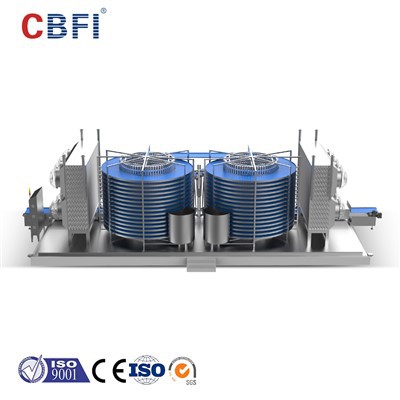


What Is a Fluidized Bed Freezer?
A fluidized bed freezer is an IQF (Individual Quick Freezing) system that uses controlled airflow to suspend food products during freezing.
In this state, each particle is surrounded by cold air, allowing more uniform heat transfer and reducing clumping or surface damage.
This method is commonly used for small or granular food products that require individual separation after freezing.
Technical Parameters
| Item | Specification |
|---|---|
| Freezing Capacity | Customized according to production line |
| Temperature Range | -35°C to -45°C |
| Applicable Product Size | 5–30 mm |
| Energy Efficiency | 25%–35% lower consumption vs conventional tunnel freezers |
| Noise Level | < 75 dB |
| Structure | Modular industrial design |
| Material | Stainless steel (304 / 316 optional) |
| Control System | PLC automated control |
Working Principle
The fluidized freezing process is based on controlled air suspension:
High-speed cold air is injected through a perforated air distribution plate
Food particles are lifted into a suspended (fluidized) state
Each particle is individually exposed to low-temperature airflow
Rapid heat exchange occurs, forming uniform freezing
This process reduces product sticking and improves freezing uniformity.
Key Applications
Seafood processing
Suitable for shrimp, fish cubes, shellfish, and other seafood products.
Key requirements:
Prevent oxidation and discoloration
Maintain texture after thawing
Avoid product adhesion during freezing
Meat processing
Used for:
Meatballs
Minced meat products
Pre-cooked meat items
Benefits include stable texture retention and reduced ice crystal damage.
Fruit and vegetable freezing
Common applications:
Strawberries
Blueberries
Mango cubes
Mixed vegetables
The system helps reduce cell rupture and juice loss during thawing.
Bakery and ready-to-eat food
Dumplings
Buns
Dough products
Supports fast freezing cycles and reduces surface cracking.
Pet food industry
Freeze-dried snacks
Meat-based pet food products
Helps extend shelf life while maintaining structure.
System Advantages
1. Faster freezing process
Compared with conventional tunnel freezers, freezing time is reduced by up to 40% depending on product type and size.
2. More uniform freezing quality
Each particle is individually exposed to airflow, reducing temperature differences inside and outside the product.
This helps reduce:
Ice crystal damage
Product clumping
Texture degradation after thawing
3. Energy efficiency optimization
The system uses variable-frequency fans and optimized airflow distribution to reduce energy consumption compared with traditional freezing systems.
4. Continuous production stability
The system is designed for 24-hour industrial operation with stable throughput and low fluctuation in freezing performance.
5. Reduced oxidation risk
Controlled airflow circulation reduces direct exposure to ambient air, helping maintain product color and surface quality.
Core Components
Fluidized bed air system
Air distribution plate designed for uniform airflow across the freezing zone, ensuring stable suspension of materials.
Evaporator system
High-efficiency finned evaporator improves heat exchange performance and reduces frost accumulation.
Control system
PLC-based control system monitors:
Temperature
Airflow speed
Conveyor speed
Operating status
Supports integration with production management systems (MES/ERP).
Optional Configurations
The system can be configured based on production requirements:
Different capacity ranges for small or large factories
304 or 316 stainless steel for high-corrosion environments
Automatic feeding systems (belt or robotic loading)
UV or ozone sterilization modules
Remote monitoring and fault diagnosis system
Industrial Applications
The fluidized bed freezer is commonly used in:
Seafood processing plants
Frozen food factories
Central kitchen production lines
Agricultural product processing
Ready-to-eat food manufacturing
It is suitable for factories requiring continuous IQF production.
Process Optimization Logic
The core advantage of fluidized freezing is airflow-based dynamic heat transfer control.
Compared with traditional tunnel freezing:
Eliminates product stacking effects
Improves heat exchange efficiency
Reduces freezing time window for microbial activity
Improves thawing quality consistency
In some dough and bakery products, rehydration performance can be improved after freezing due to reduced ice crystal damage.
Maintenance and Operation
The system is designed for industrial maintenance cycles:
Routine maintenance interval: approx. 2000 operating hours
Modular structure allows fast component replacement
Suitable for continuous production environments
Frequently Asked Questions
What products are suitable for fluidized freezing?
Small or particulate food products such as seafood, diced meat, vegetables, fruits, and bakery items.
What is the main difference from tunnel freezers?
Fluidized systems suspend products in airflow, while tunnel freezers rely on belt transport and layered cooling.
Can the system run continuously?
Yes. It is designed for 24-hour continuous industrial production.
Is product sticking a common issue?
No. Fluidization reduces product contact, significantly lowering the risk of clumping.
Industrial Value
The CBFI fluidized bed quick freezer is designed for:
Improving production line efficiency
Stabilizing product quality
Reducing freezing time
Supporting large-scale continuous food production
It is widely used in modern IQF production lines where consistency and throughput are key requirements.
Hot Tags: Fluidized Bed Quick Freezer (IQF System), China, manufacturer, factory, price, buy