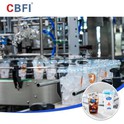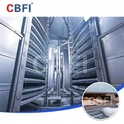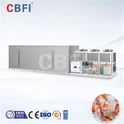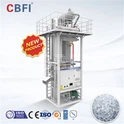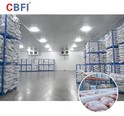

Fluidized bed quick freezing machine (also known as fluidized bed quick freezing machine or single freezing machine) is a device that achieves rapid freezing through fluidized bed technology. Its core principle is to place the material to be frozen in a low-temperature environment, suspend the material through forced airflow, and form a "fluid" like motion state. This technology breaks through the limitations of traditional quick freezing equipment, allowing food to be uniformly cooled during the freezing process while preserving its original form, color, and nutritional content.
Technical Characteristics Analysis
1. Fluidization dynamic freezing
The airflow system designed inside the equipment blows low-temperature cold air from the bottom or side, causing material particles to suspend and form a "fluidized" state under the action of the airflow. This dynamic contact method significantly improves heat exchange efficiency and shortens freezing time. For example, traditional flatbed freezers may take 2-4 hours to freeze vegetables, while fluidized bed freezers can complete it in 30-60 minutes, increasing efficiency by 3-5 times.
2. Precise temperature control and layered design
Modern fluidized freezing machines often adopt multi temperature zone layered control technology, which can adjust temperature parameters for different materials. For example, for strawberries with high moisture content, the equipment can set a pre cooling zone of -30 ℃; For fibrous vegetables such as bamboo shoots, a gradient cooling of -25 ° C to -40 ° C is used to avoid taste damage caused by cell rupture.
3. Advantages of automation and modularization
Some high-end models are equipped with PLC intelligent control systems, which can achieve real-time monitoring and automatic adjustment of parameters such as temperature, airflow velocity, and feed rate. Modular design also enables flexible expansion of equipment according to production scale, suitable for the needs of small and medium-sized enterprises to large processing plants.
Core application scenarios and industry requirements
1. Deep processing of agricultural products
The primary application of fluidized freezing machine is the processing of frozen fruits and vegetables. Taking bamboo shoots as an example, if fresh bamboo shoots are not processed in a timely manner after harvesting, they are prone to quality decline due to enzymatic browning and microbial growth. Through fluidized freezing technology, the center temperature of bamboo shoots can be quickly reduced to below -18 ℃, effectively inhibiting enzyme activity and microbial reproduction, while reducing the damage of ice crystals to cell structure. After thawing, the crispy and tender taste can still be maintained.
2. Fruit preservation and export processing
For perishable fruits such as strawberries and mangoes, traditional freezing methods can easily cause frost on the surface and softening of the flesh. Fluidized freezing technology forms tiny ice crystals through rapid freezing (usually at a freezing rate of ≥ 50 ℃/hour), minimizing cell damage to the greatest extent possible. For example, after a Southeast Asian mango export enterprise used this equipment, the product damage rate decreased from 12% to 3%, and the export qualification rate significantly improved.
3. Industrial production of food
In the field of pre packaged vegetables and convenience foods, fluidized freezing machines can standardize the freezing of conditioned vegetables, fruit and sauce, ensuring stable product batches. For example, a fast food brand makes "frozen Fried Rice bag" by mixing carrot granules with frozen beef. It maintains the independence of ingredients through fluidization and quick freezing, avoids adhesion, and can still present a clear taste after reheating.
Technological Evolution and Market Trends
1. Energy efficiency optimization and environmental protection upgrade
In recent years, the industry has focused on breakthroughs in energy-saving technologies. The new equipment adopts environmentally friendly refrigerants, variable frequency compressors, and waste heat recovery systems, reducing energy consumption by 15% -25% compared to traditional models.
2. Intelligent and data-driven management
Some high-end models have introduced IoT technology, which allows real-time uploading of device operation data (such as freezing time, temperature fluctuations, energy consumption) to the cloud, facilitating production process optimization for enterprises.
3. Industry standards and policy promotion
The "Technical Specification for Frozen Food Processing" released by China in 2023 explicitly requires fluidized bed quick freezing equipment to be equipped with an online monitoring system and specific indicators for freezing rate. At the same time, the national subsidy policy for cold chain logistics (such as a subsidy of 10% -15% of the total equipment price for the purchase of cold chain equipment) further promotes the popularization of this technology.
If you are interested in more details about this product,please contact with
E-mail:cbfi@icemakerchina.com
Mobile: +86-18929552761 (WhatsApp/ WeChat)