

Limitations of Traditional Filling Cooling Methods
1. Uncontrolled Water Dilution and Quality Instability
Crushed ice melts rapidly during mixing, causing direct water integration into fillings, which results in:
Moisture imbalance: Disruption of formulation precision (e.g., 5%–7% moisture tolerance in bakery fillings)
Texture degradation: Structural collapse in high-precision products such as pastry and meat fillings
Microbial risk: Meltwater exposure increases contamination probability (e.g., E. coli, Staphylococcus aureus)
Additional cost burden: Requires stabilizers or corrective additives, increasing raw material cost by ~0.8%–1.2%
2. Temperature Runaway During Mixing
In standard workshop environments (>25°C in summer):
Microbial growth rate increases significantly with every +5°C temperature rise
Volatile flavor compounds in meat and seasoning systems can decrease by up to 30%
Thermal instability reduces batch consistency and product shelf life
3. Inefficient and Non-Hygienic Handling Process
Manual ice handling increases cross-contamination risk
Separated ice production and processing lines increase logistics cost and energy waste
Annual internal ice logistics costs can exceed significant operational thresholds in medium-scale plants
CBFI Solution: Controlled Tube Ice Engineering System
Core Innovation: Dynamic Tube Ice Thermal Regulation
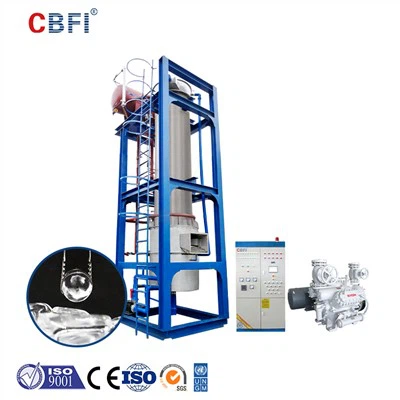
The CBFI integrated tube ice system replaces crushed ice with engineered tube ice structures featuring controlled geometry and melting behavior.
1. Precision Tube Ice Formation System
Ice geometry: cylindrical tube ice (approx. 3 cm diameter, adjustable length)
Internal structure: controlled micro-hollow formation for predictable heat exchange behavior
Production system: spiral tube ice formation technology for uniform density and stability
2. Predictable Phase Transition Behavior
Unlike irregular crushed ice, CBFI tube ice provides linear and controllable melting kinetics:
Controlled melting rate ensures gradual heat absorption
Maintains filling temperature stability within 4–8°C range during mixing
Extends low-temperature retention time by approximately 2× compared to crushed ice systems
3. Moisture Control and Product Stability
Melted water is evenly distributed within the filling matrix
Improves hydration consistency without localized over-dilution
Enhances water retention performance in structured fillings (e.g., dumpling filling systems reaching up to 98% retention stability under controlled conditions)
4. Hygienic Inline Ice Supply Integration
Eliminates manual ice handling steps
Closed-loop production-to-process transfer reduces contamination exposure
Integrates directly into mixing workflow for continuous hygienic operation
Engineering Value in Food Processing Applications
The system functions not only as a cooling device but as a process control subsystem in modern food manufacturing:
Stable low-temperature mixing environment
Controlled moisture integration instead of uncontrolled dilution
Improved microbial control through temperature stability
Enhanced batch-to-batch consistency in industrial production
Conclusion
The CBFI Integrated Tube Ice Machine redefines the role of ice in food processing. It shifts from a passive cooling medium to an actively engineered process parameter, enabling:
Precision temperature control
Hygienic inline operation
Controlled moisture delivery
Improved product stability and shelf life
This represents a transition toward standardized, low-temperature intelligent processing systems in modern food manufacturing.

Hot Tags: CBFI Integrated Tube Ice Machine Applied in Filling Mixing Process, China, manufacturer, factory, price, buy, 1 ton tube ice machine, ice tube maker machine, ice tube machine