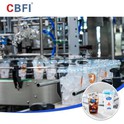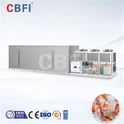

As the pressed pork patties pass through the inlet and smoothly enter the twin-spiral quick-freezing machine along the conveyor belt, a microscopic transformation unfolds. Compared to ordinary freezing equipment, specialized quick-freezing machines can rapidly lower the core temperature of the product below -18°C within an extremely short time, allowing it to quickly pass through the ice crystal formation zone. The key to this process is speed-the ice crystals produced by rapid freezing are small and evenly distributed, avoiding physical damage to the meat's fiber structure.
For buyers, this technical detail translates into quantifiable product advantages. According to actual test data, pork patties processed with appropriate quick-freezing techniques can reduce juice loss to below 3% after thawing, far lower than the 8%-12% loss rate of ordinary frozen products. This means that for every 100 kg of product, catering companies can obtain an additional 5-9 kg of usable raw material. In large-scale operations, this difference directly translates into cost control and product consistency-juice retention not only affects flavor but also directly impacts the weight and dimensional stability of the cooked product.
From a microscopic perspective, the cell damage rate of high-quality frozen pork patties is less than 15%, while slow-frozen products can have a damage rate exceeding 40%. This preservation of structural integrity allows the product to better maintain its shape during subsequent cooking, reducing shrinkage and ensuring consistent specifications for each serving. For chain restaurants, this consistency is directly linked to stable average order value and brand reputation maintenance.
**Diverse Application Scenarios: The Infinite Possibilities of a Pork Patty** Competition in the modern catering industry has expanded from the flavor of a single dish to the overall efficiency of the supply chain. As a pre-made semi-finished product, the true value of frozen pork patties lies in their adaptability to different catering scenarios.
In the fast-food chain sector, standardization and speed of service are lifelines. Optimized frozen pork patties take only 6-8 minutes from freezing to cooking, reducing cooking time by approximately 30% compared to traditional frozen products. Data from a mid-sized burger chain shows that after adopting frozen patties, the single-store serving capacity increased by 18% during the lunch peak, and the average customer wait time decreased by 2.5 minutes. This efficiency improvement is significant in large-scale operations-equivalent to an additional 540 servings of sales potential based on 3,000 orders per day.
Supermarket retail scenarios place higher demands on the home-cooking friendliness of products. Modern family kitchens pursue "professional-grade taste with simplified operation." Frozen pork patties, due to their good structural integrity, allow even infrequent cooks to easily prepare juicy and firm patties. Retailer feedback data shows that semi-finished meat products clearly labeled "frozen for freshness" have a 34% higher repurchase rate than ordinary products, becoming a high-turnover category in the freezer.
It's worth mentioning that these products are highly adaptable to various cooking methods. Whether directly pan-fried to make hamburger patties, used as an ingredient in meat sauce noodles and meatball soup, or innovatively applied to Chinese dishes such as steamed pork patties with eggs and salt and pepper pork patties, their performance is stable and reliable. This flexibility provides a basic raw material guarantee for catering companies' menu innovation and reduces the supply chain risks of new product development.
**Supply Chain Value: From Cost Center to Efficiency Engine**
From a traditional procurement perspective, frozen meat products are often seen as a "necessary but unavoidable" choice-a compromise between convenience and freshness. However, modern quick-freezing technology is rewriting this perception, transforming frozen products from a mere cost item into a driver of supply chain efficiency.
Inventory turnover efficiency is one of the core indicators that catering companies focus on. Quick-frozen pork patties can have a shelf life of 12-18 months at -18°C, but excellent product design should also consider the convenience of "first-in, first-out" inventory management.
Logistics and warehousing optimization are equally important. Regularly shaped quick-frozen meat patties allow for higher loading density, improving cold chain transportation efficiency by approximately 15%-20% compared to irregularly shaped frozen meat. For national brands, this translates to lower unit logistics costs and smaller warehousing space requirements.
Food safety is the lifeline of modern catering enterprises. A standardized quick-freezing process includes multiple quality control points: from raw material inspection upon arrival and processing environment monitoring, to temperature tracking during quick-freezing, and finally to microbial testing of finished products. A complete traceability system ensures that every batch of products can be traced back to the source of raw materials and processing time. This transparent quality control reduces food safety risks for catering enterprises and reduces the investment required to build their own testing systems.
**Cost Structure Analysis: Hidden Long-Term Value**
Purchasing decisions are essentially a trade-off between cost and value. The price structure of frozen pork patties may seem simple, but it actually encompasses multiple value dimensions.
Direct cost comparisons show that the unit price of high-quality frozen pork patties may be 8%-12% higher than ordinary frozen products, but comprehensive cost analysis often reveals different results. The actual usage costs for catering businesses should include multiple factors such as thawing losses, cooking shrinkage, labor handling time, and energy consumption. Annual data analysis from a mid-sized chain restaurant shows that although the unit price of frozen pork patties is higher, the overall yield improvement, shorter cooking time, and labor cost savings actually reduced the overall raw material cost by 5.7%.
The return on investment cycle is another key consideration. For newly opened restaurants, using standardized frozen semi-finished products can reduce kitchen space requirements, lower equipment investment, and shorten employee training time. Calculations show that initial investment for such stores can be reduced by 15%-20%, and the opening preparation period shortened by 25%-30%. For restaurant brands in the expansion phase, this standardized support directly accelerates the ability to scale up replication.
It's worth noting that with the popularization of quick-freezing technology and the expansion of the market, the cost advantages of large-scale production are gradually becoming apparent. Leading quick-frozen food manufacturers, by optimizing equipment utilization and increasing production automation, are able to offer more competitive pricing without compromising quality. Purchasers can further optimize procurement costs through long-term cooperation agreements and large-scale purchasing.
**Market Positioning and Trends: Seizing the Entry-Level Product Opportunity in the Pre-Cooked Meal Wave** China's pre-cooked meal market is expanding at an average annual growth rate of over 20%, and its market size is projected to exceed one trillion yuan by 2025. Within this wave, frozen pork patties, as a basic semi-finished meat product, occupy a unique position-they are both an entry-level product and a quality benchmark.
Consumer research data shows that in the early stages of trying pre-cooked meals, consumers tend to choose categories with moderate processing and familiar cooking methods. Pork patties, a common product in both Chinese and Western cuisine, boast an acceptance rate as high as 76%, becoming one of the "entry-level products" for pre-cooked meal consumption. This high acceptance translates into low market education costs for catering companies, making it easier for consumers to accept dish innovations based on pork patties.
Product innovation trends show that basic frozen meat patties are gradually developing towards functional segmentation. Product variants optimized for different cooking methods are constantly emerging: patties suitable for pan-frying emphasize surface caramelization and internal juiciness retention; products suitable for stewing emphasize their ability to hold their shape even after prolonged cooking; and versions optimized for new kitchen appliances such as air fryers adjust the oil ratio and shaping method. This refined product strategy provides buyers with more diverse choices, allowing them to precisely match product specifications to their needs.
The development of industry standards is also noteworthy. As industry standards for frozen meat products gradually improve, product quality evaluation systems are expanding from simple safety indicators to comprehensive dimensions such as taste, nutritional retention, and cooking performance. Leading companies have begun to establish product development systems based on consumer cooking experiences, directly integrating end-user feedback into product optimization processes. This market-driven R&D model ensures products consistently meet actual usage needs.
https://www.icemachinesource.com/iqf-quick-freezer/
If you are interested in more details about this product,please contact with
E-mail:cbfi@icemakerchina.com
Mobile: +86-18929552761 (WhatsApp/ WeChat)