
How the 40-Ton Integrated Tube Ice Machine Solves the Traditional Problems of Large Ice Plants

In recent years, the global industrial refrigeration and edible ice market has been undergoing a major transformation. As seafood processing, cold-chain logistics, beverage supply chains, and industrial cooling industries continue expanding, the demand for large-capacity ice systems is increasing rapidly.
However, traditional large-scale tube ice machines still face several long-standing operational bottlenecks:
Large installation footprint
High civil engineering and installation costs
Long commissioning cycles
Complicated on-site piping and welding
High maintenance risks
Energy inefficiency under high ambient temperatures
For large ice plants and industrial users, these issues directly affect ROI, operational efficiency, and peak-season profitability.
This is precisely why integrated tube ice machines are becoming one of the most important trends in the commercial and industrial ice-making sector.
Among the newest developments in this field, the 40-ton integrated tube ice machine has emerged as a major technological milestone for the global ice-making industry.
What Is an Integrated Tube Ice Machine?
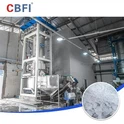
An integrated tube ice machine is a highly integrated industrial ice-making system that combines the evaporator, refrigeration unit, oil supply system, electrical control system, and piping structure into one compact modular design.
Unlike conventional split-type tube ice machines that require extensive on-site assembly, integrated systems are factory pre-assembled, pre-tested, and pre-commissioned before shipment.
This fundamentally changes the deployment model of industrial ice plants:

Traditional Split-Type Ice Machines
Multiple equipment modules
Complex on-site welding
Long installation periods
Large space occupation
High transportation and labor costs
Integrated Tube Ice Machines
Compact all-in-one structure
Plug-and-play deployment
Minimal on-site installation
Faster commissioning
Lower lifecycle costs
For industrial buyers, this means faster project execution and quicker revenue generation.
Why Large Ice Plants Are Moving Toward Integrated Designs
1. Space Optimization Is Becoming Critical
Land costs and factory rental expenses continue rising globally, especially in:
Southeast Asia
Middle East
Latin America
Coastal seafood processing zones
Traditional 40-ton split-type systems typically require:
Separate evaporator structures
External refrigeration skids
Additional piping corridors
Larger machine rooms
Integrated systems dramatically reduce the occupied footprint.
A modern 40-ton integrated tube ice machine can reduce installation space by approximately 43% compared with traditional split-type systems while simplifying plant layout planning.
Faster Installation Means Faster Profitability
In commercial ice production, time-to-operation directly impacts revenue.
Traditional industrial ice systems often require:
Pipe welding
Refrigerant charging
Alignment calibration
Electrical integration
Repeated leak testing
Installation and commissioning can take several weeks.
Integrated systems change this completely.
Because the equipment is fully tested before delivery, users only need:
Water connection
Power connection
Basic commissioning checks
This can reduce installation time by up to 80%.
For seasonal ice markets such as:
Fishing ports
Seafood processing
Summer beverage supply
Agricultural cold chain
Entering production even two weeks earlier can significantly increase annual profitability.
Energy Efficiency Is Now a Core Competitive Factor
Energy consumption remains one of the largest operating costs in industrial ice production.
Modern integrated tube ice systems are increasingly adopting:
Semi-flooded refrigeration technology
High-efficiency heat exchange systems
Intelligent oil management systems
Advanced compressor optimization
These technologies improve:
Refrigeration efficiency
Ice uniformity
Capacity stability
Compressor lifespan
For example, semi-flooded heat exchange systems allow refrigerant to fully contact heat transfer surfaces, improving thermal efficiency and reducing crushed ice generation.
In high-temperature environments, this becomes especially important.
Many traditional systems suffer major production drops at ambient temperatures above 35°C, while advanced integrated systems can still maintain near-full-load performance.
Why Compressor Technology Determines Long-Term Stability
In industrial refrigeration equipment, the compressor is effectively the "heart" of the system.
Large-capacity tube ice machines increasingly rely on screw compressors because they offer:
Stable continuous operation
Higher refrigeration efficiency
Better load adaptability
Lower vibration
Longer service life
Systems equipped with high-end screw compressors and intelligent oil circulation technology can significantly reduce:
Liquid slugging
Lubrication failure
Thermal overload
Unplanned downtime
For large edible ice factories operating 24/7, reliability is often more important than initial purchase price.
Even a single day of downtime during peak season can create substantial economic losses.
The Growing Importance of ASME Manufacturing Standards
As industrial buyers become more quality-focused, pressure vessel manufacturing standards are becoming increasingly important in global procurement decisions.
ASME-certified manufacturing standards are widely recognized as one of the highest international standards for pressure equipment safety and reliability.
For industrial tube ice machines, this directly affects:
Refrigeration system sealing performance
Pressure resistance
Weld reliability
Long-term leakage control
Equipment lifespan
High-standard welding processes combined with non-destructive testing technologies such as:
Radiographic testing
Ultrasonic testing
Penetrant testing
can dramatically reduce long-term operational risks.
Applications of Large Tube Ice Machines
Large-capacity tube ice systems are widely used across multiple industries.
Seafood Processing
Tube ice provides rapid cooling while minimizing physical damage to seafood products.
Cold Chain Logistics
Stable low-temperature transportation improves food safety and shelf life.
Industrial Cooling
Industrial ice is commonly used for:
Concrete cooling
Chemical processing
Mine cooling
Temperature control systems
Supermarket & Distribution Systems
Edible tube ice is increasingly used in:
Fresh food retail
Beverage chains
Ice distribution centers
Fishing Vessel Ice Supply
High-density tube ice is ideal for long-duration marine preservation applications.
Future Trends in Industrial Ice-Making Equipment
The future direction of industrial refrigeration equipment is becoming increasingly clear:
1. Higher Integration
Factory-integrated modular systems will gradually replace complex split-type structures.
2. Lower Energy Consumption
Energy-saving refrigeration technologies will become standard requirements.
3. Faster Deployment
Plug-and-play industrial systems will dominate emerging markets.
4. Intelligent Monitoring
Remote diagnostics and smart control systems will become mainstream.
5. Lifecycle Cost Optimization
Industrial buyers are focusing more on total operating cost rather than initial purchase price alone.
The New Era of Industrial Tube Ice Machines
The industrial ice-making industry is entering a new phase of technological evolution.
Integrated tube ice machines are no longer simply equipment upgrades - they represent a transformation in:
engineering efficiency,
installation methodology,
operational economics,
and industrial refrigeration design philosophy.
For large-scale ice plants, seafood processors, cold-chain operators, and industrial cooling companies, choosing the right high-capacity tube ice system increasingly means choosing:
faster deployment,
lower operational risk,
higher energy efficiency,
and stronger long-term competitiveness.
As global demand for industrial refrigeration solutions continues growing, integrated large-capacity tube ice machines are expected to become one of the defining technologies of the next generation of commercial ice production.